

Making Space for AI: Why Personal Transformation Precedes Organizational Success
Making Space for AI: Why Personal Transformation Precedes Organizational Success
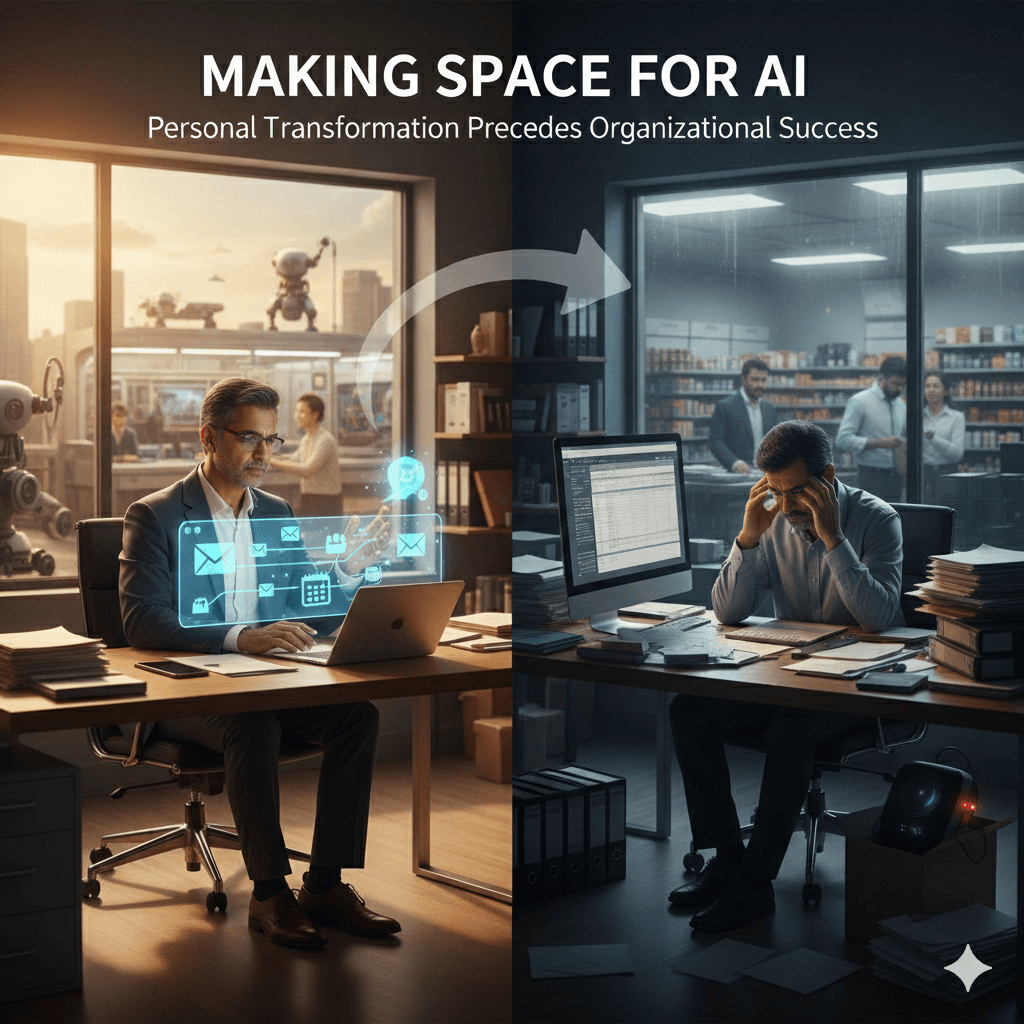
A wake-up call for leaders who want to prepare their organizations for the future of work
“I don’t need AI for my strategic work. But I can see how my team would benefit tremendously.”
Every time I hear a leader say this—and I hear it constantly—I know their organization’s AI transformation is already failing. They just don’t know it yet.
This isn’t pessimism. It’s pattern recognition from two years of working with mid-market companies on AI transformation. The evidence is unambiguous: If you’re not using AI in your own daily work, your organization’s AI transformation will fail. No exceptions.
Not because of budget constraints. Not because of technical limitations. Not because your team isn’t capable. But because you’ve fundamentally misunderstood where organizational transformation begins.
It begins with you being willing to work differently. Before you ask anyone else to

The Leadership AI Audit Your Team Is Already Conducting
Your team is watching you right now. How you handle email. How you prepare for meetings. How you make decisions. They’re making judgments about whether AI is truly strategic or just another initiative that leadership talks about but doesn’t practice.
The pattern across mid-market companies is unforgiving: when leaders don’t transform personally, organizations don’t transform at all. Your team doesn’t need another strategy document. They need to see you work differently.
Two Leaders, One Choice
Two non-technical CEOs. Both are running significant Indian companies. Both are committed to AI transformation. Their paths diverged at a single decision: making space
for AI in their own daily work.
The first leader runs a premium manufacturing business. He started with his email—90 minutes each morning became 30 minutes by giving his AI assistant access to his inbox. Not to write emails for him, but to help him think through them better. Then he tackled meeting preparation: 15 minutes before every significant discussion with his AI partner, war-gaming scenarios, and identifying blind spots.
His specific daily practice: Morning review with AI, pre-meeting strategic thinking sessions, evening decision analysis, asking “What am I not seeing?” The discipline was giving AI genuine access to his work context, not just occasional queries.
Six months later, his organization is systematically elevating AI capabilities—not because he mandated it, but because his team watched him transform.
The second leader runs a large-scale retail operation. He understood AI’s potential intellectually. Attended workshops. Installed tools. But he couldn’t break his twenty-year habit of manually processing every email, couldn’t give AI access to his actual work systems, couldn’t persevere through the awkward early weeks.
His daily routine remained unchanged. His organization watched. Two years later, after investing crores in AI tools and training, the tools sit unused. The team is cynical. The failure was leadership’s unwillingness to model transformation.
The difference wasn’t technical capability or company resources. It was leadership discipline to transform first.
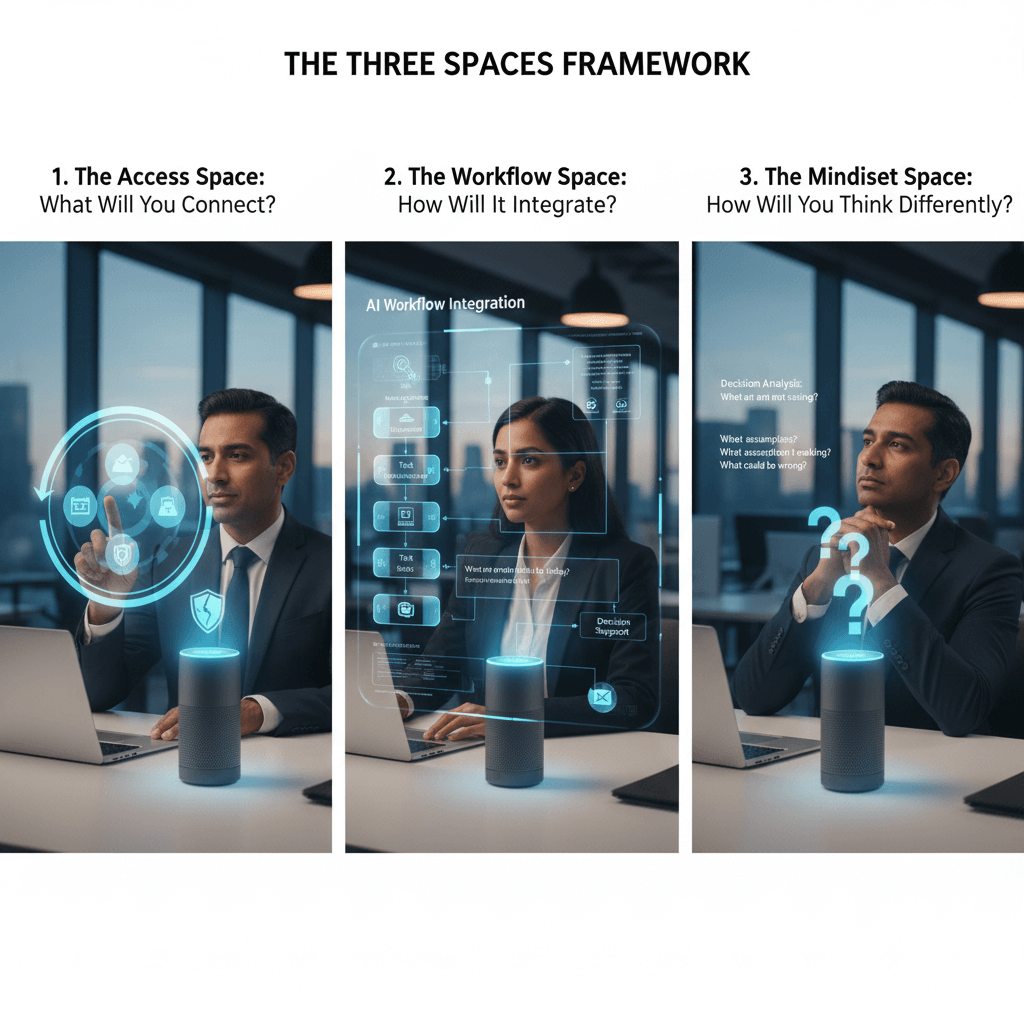
The Three Spaces Framework
Making space for AI requires three integrated changes:
- The Access Space: What Will You Connect?
Most leaders want AI to be helpful while keeping it at arm’s length from actual work. Transformation requires integration. Give your AI assistant access to your email, calendar, and key documents. This feels uncomfortable—there’s visceral resistance to letting AI into your “real” work. But this access is precisely what enables AI to become a thinking partner rather than a party trick.
The hard truth: If you’re not willing to give AI meaningful access to your work systems, you’re not serious about transformation. - The Workflow Space: How Will It Integrate?
This is where most leaders fail—not in understanding AI’s potential, but in actually changing daily habits.Integration means embedding AI into your actual work rhythm. I start each morning asking my Chief of Staff: “What are the main tasks for today?” Because I ended yesterday by updating my key task list, my CoS has persistent context—it reads from organized files where it maintains continuity on my priorities, commitments, and ongoing projects.This isn’t about automation. It’s about having a thinking partner with institutional memory who helps you maintain strategic focus across days and weeks, not just within isolated moments.The shift: from treating each AI interaction as a standalone transaction to building a persistent workflow partnership. - The Mindset Space: How Will You Think Differently?
The deepest shift: Stop seeing AI as a tool. Start treating it as a thinking partner.One specific practice makes the difference: Never finalize a major decision without asking AI, “What am I not seeing? What assumptions am I making? What could go wrong?” This discipline of systematic perspective-taking elevates decision quality dramatically.Not because AI is smarter than you, but because the partnership makes you sharper
Building Your AI Team (Not Just Using AI Tools)
Here’s what separates leaders who actually transform from those who dabble: they build an AI team, not just use AI tools.
Most people are still transactional with AI—they copy and paste questions into ChatGPT, receive responses, and close the tab. No context across sessions. No persistent knowledge. No relationship. They’re using AI like a vending machine, not building a partnership.
Leaders who transform think differently. They create AI personas—specialized team members with distinct roles and persistent context. Think of it like hiring: you wouldn’t have one generalist employee handle everything from finance to strategy to research. You build a team with specialists.
Your AI Team Structure
Start by creating distinct personas using Projects (in Claude) or custom GPTs (in ChatGPT):
Chief of Staff: Your most-used persona with the deepest context about you, your work, and your organization. Handles daily operations, meeting prep, decision support, and communication drafting. This is your right hand.
Strategic Advisor: Focused on big-picture thinking, scenario planning, competitive analysis, and long-term implications. You bring strategic challenges here, not operational questions.
Financial Analyst / Technology Researcher / Domain Specialists: Add personas based on your specific needs, just like you’d hire specialized team members as your organization grows.
The key insight: these aren’t just different prompts. They’re distinct personas with persistent context, trained on different aspects of your work.
Training isn’t about technical setup—it’s about context discipline.
First, create organized folder structures your AI can navigate. Desktop AI clients (Claude Desktop, ChatGPT Desktop) can access your local files, Google Drive, OneDrive. Give them this access.
Then, build context deliberately. I’ve created a file structure where my Chief of Staff writes summaries, tracks decisions, and maintains context. When I need strategic thinking, it reads from these organized folders rather than starting from zero each time. This isn’t complicated—it’s just disciplined information organization with AI access in mind.
The critical shift: stop thinking transactionally. Start building persistent knowledge. Each interaction should make your AI team smarter about your context, not reset to zero.
Full disclosure: I’m writing this article with my AI Chief of Staff. Not because I can’t write, but because this is exactly the partnership I’m describing—I’ve given this persona access to my strategic documents, trained it on my thinking, and we’re collaborating on articulating what I’ve learned from two years of transformation work. The meta-irony of using AI to write about AI leadership isn’t lost on me. But it proves the point: when you build context and genuine partnership, AI becomes useful for actual strategic work, not just generic tasks.
Common Sense About Sensitive Information
Use judgment about what you share, especially with cloud-based models. Organize your information so you control what AI accesses. Desktop-based AI clients give you more control over data security.
But don’t let security concerns become an excuse for not transforming. Most leaders who cite “security concerns” haven’t actually assessed risks—they’re using it as intellectual cover for not wanting to change their habits
The Economic Imperative
When a mid-market CEO doesn’t master AI personally, the cost isn’t their own productivity—it’s organizational opportunity cost.
If an AI partnership could improve each leadership team member’s decision quality by even 10%, better strategic choices, faster problem-solving, and more effective
resource allocation—the impact compounds across every function they oversee.
But the deeper cost is cultural. When leaders don’t model AI integration, they signal it’s optional, experimental, and not serious. The best employees—who recognize AI as a career imperative—start looking elsewhere. The organization develops “AI tourism culture”: lots of talk, presentations, no transformation.
Meanwhile, competitors whose leaders have personally mastered AI are moving faster, making better decisions, and creating market distance.
The gap isn’t about technology. It’s about leadership courage to transform first.
The 2027 Leadership Divide
By early 2027—just over two years from now—there will be two types of leaders. Those who personally mastered AI integration in 2025 and whose organizations naturally followed, creating systematic capabilities embedded across operations. And those who spent 2025 talking about AI transformation while personally avoiding it, whose expensive infrastructure sits unused, whose best people have left for AI-fluent companies. The division is being determined by daily choices leaders make now about their own work habits.
Your Path: The Next 90 Days
Between now and mid-February 2026, commit to personal AI integration before asking anything of your team.
Weeks 1-4: Foundation Start with email. Give your AI Chief of Staff access to your inbox. Work with it daily. Persist through the awkward phase where it doesn’t quite understand your context yet. Create the file organization where it can maintain persistent knowledge about your work.
Weeks 5-8: Expansion Add a second persona—Strategic Advisor for major decisions. Begin sharing openly with your leadership team what you’re learning. Model the learning process, not just results.
Weeks 9-12: Modeling Make your AI integration visible to your broader organization. Not as achievement but as possibility. Add specialized personas based on your needs. Let your transformation be the case study that inspires theirs.
At 90 days, evaluate honestly: Have you personally transformed how you work? If yes, you’re ready to lead organizational transformation. If not, you know why your AI initiatives keep stalling.
The Choice
Look at your calendar from last week. Your emails. Your meeting prep. Your decision-making process.
Now answer honestly: If your entire leadership team worked exactly the way you worked last week, would your organization be ready for 2027?
If you hesitated, you’ve identified the real barrier to your organization’s AI transformation. And it’s not technology, budget, or team capability. It’s you.
Organizational AI transformation begins with personal AI transformation. Not because individual productivity matters most, but because leadership modeling determines organizational culture. Your team is watching how you actually work—not what you say in town halls, but whether you’ve changed anything about your daily practice.
The good news: You can start today. Not with a strategy document or budget allocation, but with a personal commitment to make space for AI in your own work. Build your AI team. Give them access. Create a persistent context. Work in genuine partnership.
The challenge: It requires exactly what most leaders avoid—being uncomfortable, breaking ingrained habits, learning publicly, and transforming before you have all the answers.
The reality: This is what leadership has always required. The AI era hasn’t changed that. It’s just made it more visible, more urgent, and more consequential.
Your organization’s AI future begins with a simple choice: Will you make space for AI in your own work this week?
Your team is watching. The market is moving. The 2027 leadership divide is being determined by choices made today.
What will you choose?