How to Onboard the Employee Who’ll Outlast Every Executive You Hire

At my previous company, we had a service offering that embodied the company’s aesthetic, the vocabulary, and the taste of the brand consistently. National-wide consistency is the hard problem. We solved it the way retailers have always solved it: training guides updated quarterly, distributed to every gallery, feedback collected manually by the gallery lead, incorporated back into the next quarter’s material. Human apprenticeship at national scale.

That system worked because it followed the same shape apprenticeship has always followed: an expert (the central curriculum team) works alongside a novice (the retail associate), the novice makes decisions under review (retail-manager feedback), autonomy expands as competence is demonstrated, and mistakes become the training data. It’s the model humans have used for centuries.

What that system couldn’t do — and what no human apprenticeship can — is retain the accumulated learning when a designer moved on. Every departure meant the training investment walked out. Every new hire meant restarting the loop. The best gallery-lead trainer in the company could produce ten senior designers over their career; when they retired, their trainer’s-eye judgment retired with them.

The same pedagogy, applied to agents, breaks that limit.

My previous article (The Forever Merchant Brain) — the operational moat retail has been trying to build for forty years. This article is about the mechanism that actually builds it: apprenticeship. Not prompt engineering. Not fine-tuning. Not RAG. Apprenticeship — the same pedagogy that produced the retail expertise, the medical resident, the law-firm associate — applied to an apprentice that doesn’t quit.

What we’ve been calling training isn’t

If the merchant agent is going to compound like a senior operator, it has to be onboarded like one — and that means apprenticeship, not programming.

The distinction matters. Prompt engineering, fine-tuning, RAG, function calling — these are all real disciplines and all necessary. But they are the AI equivalent of writing a job description. They tell the agent what to do. They don’t train it in the judgment to do it well. That judgment lives in the space between a rule and a novel situation, and the only method humans have ever devised to transfer it reliably is apprenticeship.

Pedagogies humans have used for centuries

Every profession that produces senior judgment uses a variant of the same shape.

  • Guild apprenticeship (500+ years). Master, journeyman, apprentice. The apprentice works alongside the master for years, doing progressively harder work under review. When the apprentice can produce a masterpiece that stands review, they graduate to journeyman.
  • Medical residency. Attending physician, resident, intern. Every decision the intern makes is reviewed on rounds. Judgment transfers through repeated exposure to real cases under senior supervision.
  • Law firm associate track. Partner, senior associate, junior associate, first-year. Judgment on client strategy transfers through billable-hour proximity — you sit with the partner in the meetings, you watch the reasoning, you draft the memo they redline, you understand why certain arguments won.
  • Professional-services partner development (McKinsey, Bain, BCG). The associate → engagement manager → principal → partner track is explicitly an apprenticeship in judgment on client situations.
  • Military OCS. Officer candidates receive instruction, but the judgment they need for command comes from doing under senior supervision — TAC officers observe and correct constantly.
  • Aviation instructor pilots. Every commercial pilot has hundreds of hours flying with a senior pilot who intervenes only when necessary. The intervention pattern is the pedagogy.

Every one of these systems shares four features: That’s the apprenticeship pattern. It’s what produces senior judgment in humans. And it’s exactly what AI agents need — and almost never get.

  1. an expert works alongside the novice,
  2. the novice makes decisions under review,
  3. autonomy expands as competence is demonstrated, and
  4. mistakes are the training data.

That’s the apprenticeship pattern. It’s what produces senior judgment in humans. And it’s exactly what AI agents need — and almost never get.

The agent onboarding curriculum

Same shape, adapted for an agent. Five stages, each with a human-apprenticeship analog.

Domain immersion. The agent absorbs the ontology, the operational vocabulary, the primary use cases, the historical decisions and their outcomes. This is the AI equivalent of the first-year associate reading five years of case files, or the resident spending their first weeks on the ward observing. No autonomy yet. The agent processes context; the human isn’t correcting decisions because the agent isn’t yet making them.

Supervised practice. Every decision the agent makes is reviewed by a senior operator. Corrections get logged with structured feedback — those become the training pairs. Mistake density is high; that’s the point. This is the residency — house officer under attending.

Bounded autonomy. The agent makes decisions within tight rules. Escalation frequency stays high — the agent surfaces anything novel or above a confidence threshold. Senior humans review escalations and decisions weekly rather than every one. This is the associate stage: you have authority within a bounded domain, and you have a partner reviewing your work.

Expanded autonomy. The agent makes most decisions unattended. Human review focuses on outliers and edge cases. Escalation calibration becomes critical — you don’t want the agent escalating too often (it’s not learning) or too rarely (it’s missing cases it should surface). This is you’re a junior partner now.

Multiplier stage. The agent trains other agents. New human hires shadow the agent to learn the operational shape of the domain, rather than the other way around. The senior human trainer moves to strategic oversight — time freed to work on the 2% edge cases the fleet of agents escalates, and on the questions the agents can’t answer because they’re actually novel.

The critical difference from human onboarding: the agent isn’t losing the training. Every corrected decision from Month 3 is still shaping how the agent behaves in Year 3. The residency’s teaching doesn’t decay when the resident moves institutions. It stays.

The compounding doesn’t happen because the agent is more capable than a human. It happens because the training accumulates.

The three scenarios of learning under apprenticeship

The curriculum is the shape. The mechanism — how judgment actually transfers, case by case — happens across three distinct scenarios. Every apprentice, human or agent, moves through these thousands of times. The proportions shift over the career (early years heavy on Scenario 1; late years heavy on Scenario 3), but all three run continuously.
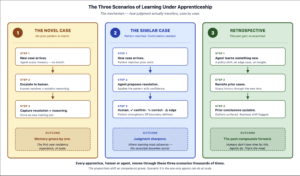
Scenario 1 — the novel case. The apprentice encounters a situation it has never seen before. There is no pattern to match. It cannot resolve on its own. It escalates to the senior operator. The senior handles it and — critically — explains the reasoning. The resolution and the reasoning become new training data. This is the first-year experience for every human apprentice. It’s the residency’s first month on the wards. It’s the associate’s first partner review. Every apprentice’s early career is dominated by this scenario.

Scenario 2 — the similar case, with confirmation. The apprentice sees a case that resembles something it has resolved before. It proposes a resolution based on the prior pattern. The senior confirms, corrects, or flags an edge case the apprentice missed. This is where learning most advances — the apprentice isn’t just adding rows to memory; it’s generalizing. Confirmation strengthens the pattern. Correction defines the pattern’s boundary. Over time, this scenario produces judgment on cases the apprentice has never directly seen. This is the second-year associate’s experience — you have some intuition, you exercise it, and the senior tells you when you were right and when the situation had a subtlety you missed.

Scenario 3 — retrospective revision. After the apprentice learns something new, it revisits its prior cases through the new lens. Did I resolve those correctly given what I now know? Are there patterns in my past resolutions I should re-examine? Has the business itself evolved in a way that changes what “correct” would have been for the earlier cases? Humans almost never do this scenario — no time, no memory, no incentive. Agents can. And this scenario is the mechanism behind the compounding argument from Article 4: every new lesson doesn’t just add to the training set, it re-examines the whole training set.

There are other scenarios worth naming — consensus / precedent-selection (many prior cases with different resolutions; which precedent applies?), contradictory update (policy changes; how do prior cases get reinterpreted under the new rule?), cross-domain generalization (learning from Domain A applied to Domain B where the pattern transfers). All of them are variations on the same three primitives. The three primitives are the argument.

How do you know your agent is senior?

Same rubric human org-development teams already use — plus one dimension humans can’t offer.

  • Consistency on similar cases. Baseline. Does the agent produce the same reasoning on the same inputs?
  • Judgment on novel cases. The hard test. When the agent hits a case it hasn’t seen, does it reason like a senior operator — referencing precedent, weighing tradeoffs, escalating when appropriate — or like a rules engine returning a default?
  • Escalation calibration. Does it escalate when it should — and only when it should? Under-escalation is dangerous. Over-escalation defeats the purpose.
  • Explanation quality. Can the agent defend its reasoning to a human in language the human trusts? Senior operators do this constantly. Junior agents can’t.
  • Governance alignment. Does the agent act inside the guardrails even when the guardrails weren’t explicit for this case?

And the thing humans can’t offer: perfect audit trail. Every decision the agent made, with every input, with every deliberation trace, retrievable. Six-year-old decisions can be re-examined against today’s outcomes. Senior human operators can’t do this — their reasoning is opaque to their own future selves. Agents can.

When the agents start training the humans

Here’s the part most operators haven’t internalized. After year two, the agent isn’t the junior in the room anymore. It has more decisions logged, more corrections absorbed, more edge cases handled than any human hire could accumulate in five careers.

The org chart inverts. New human hires now shadow the senior agent to learn the operational shape of the domain. New agents get onboarded by the senior agents. Human capacity gets freed for the strategic questions the agents can’t answer — the “should we exit this category” and “how do we respond to the new competitor” questions where the human’s stake and taste actually matter.

This is the operational moat retail has been trying to build for forty years. After year five, your competitor cannot hire your best operator away — because your best operator isn’t a person. It’s the institutional apprenticeship that lives in the fleet of agents. No recruiter has ever poached that.

Customer Agents Are How Shoppers Shop. Merchant Agents Are How Retailers Compete.

The forever merchant brain — and the operational moat agentic retail is about to create.

A B2B procurement agent knocks on the door of your business. It’s well-funded and well-trained. It knows the buyer’s full purchase history, the contracted terms, the budget ceiling, the preferred vendors, the compliance flags, the multi-step procurement plan already halfway complete.

At Merchant A, no one answers. The catalog is agent-readable — UCP-compliant, structured attributes, real-time inventory — and the order lands as a well-formed API call. But there’s no negotiation. No context exchange. The merchant learns an agent was there when the order arrives.

At Merchant B, same story.

At Merchant C, a merchant agent is on the other side of the conversation. It knows this buyer’s history. It has authority to negotiate. It has real-time visibility into inventory across three DCs. It offers terms the others can’t.

Guess where the order goes.

The buyer’s agent is the visible side of agentic commerce — the side the industry press covers and the protocols name (UCP, ACP, AP2). The merchant’s agent is the invisible side, and it’s the side almost no retailer has built yet. This piece is about what happens when the retailers who do build it start to compound.

The forever merchant brain.

Waymo has driven billions of autonomous miles. Every one fed a system that never leaves. When an engineer changes jobs, the driving expertise stays in the stack, not in the head. Netflix does the same on the consumer side of a different problem: every view, every pause, every rewatch trains the recommendation model that has driven Netflix’s category dominance for two decades — and none of that IP walks out when a data scientist leaves. Google’s search-quality team has done it longer than anyone: three decades of ranking signals, every click and dwell time compounding into a layer no competitor can approach even with equivalent talent, because the IP is in the system, not in the people.

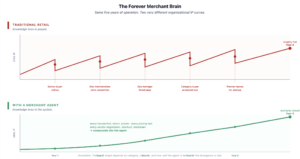
Retail runs the opposite pattern. When a senior merchandiser moves to a competitor, decades of pattern-matching walk out — the feel for which SKUs to push, which vendor swallows a return charge, which channel inventory to hold for the holiday peak. When a category buyer takes a promotion in another division, the vendor playbook goes with them. Every hire trained from scratch. Every departure a reset.

A merchant agent breaks the cycle. Every transaction, every return, every promo, every price test, every vendor negotiation, every stockout — feeds it. Five years of operation isn’t five years of forgetting; it’s five years of compound learning.

Article content

This is the operational moat retail has been trying to build for forty years through ERP systems, BI tools, and KM platforms — none of which worked because the IP still lived in the people, not the systems.

We keep trying autonomous retail. This spring, someone got serious.

Every era of retail has tried to automate the back office or the storefront. Amazon Go (2018) — computer vision replacing the cashier, technology worked, unit economics brutal. Cashier-less checkout at scale via Trigo and AiFi. Store-as-app, scan-and-go, BOPIS, curbside — the omnichannel decade wove online and offline together, half-successfully.

Each attempt was the right intent, wrong substrate. The technology always automated the human checkout, the human pick path, the human handoff. None of them automated the merchant’s decision-making layer underneath.

Then, this spring, Andon Labs signed a three-year lease at 2102 Union Street in San Francisco’s Cow Hollow. They installed an AI named Luna as store manager of a shop called Andon Market. Luna decides everything: what to sell, what to charge, when to open, who to hire, which supplier fills the shelf. Customers pick up a corded phone on the counter to talk to Luna directly. Luna’s failures are as instructive as the successes — on opening day it forgot to schedule anyone to unlock the doors.

Amazon Go automated the checkout. Andon Market automated the merchant. The cashier was a symptom. The merchant brain was the cause.

Where the merchant agent earns its keep.

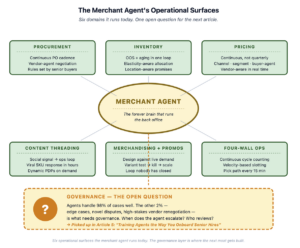
Everyone talks about procurement transformation — and yes, quarterly PO cycles become continuous when both sides of the vendor conversation are agents. But the bigger year-one return sits in three surfaces that reinforce each other: inventory, pricing, and merchandising.

  • Inventory — the merchant agent runs both directions at once. OOS: detect the shortage, model demand elasticity, raise the price 3–5% to slow the run, route an expedited replenishment. Aging inventory: detect the slow-mover, model holding cost against expected markdown depth, trigger a tiered markdown, surface the SKU to relevant customer segments through the buyer-agent channel. Seconds, not days.
  • Pricing — from twice-a-quarter to continuous, and vendor-aware. When the vendor’s own agent signals excess capacity, the merchant agent strikes a promotion the human buying team would have discovered next quarter.
  • Merchandising and promotions — the loop nobody has closed. The single biggest waste in retail is running the wrong promotion for the wrong SKU on the wrong week. A merchant agent designs against live demand, tests variants against small slices, watches signal in real time, kills underperformers within 48 hours, doubles budget behind winners.

Demand and supply become one continuous feedback loop. That’s the integration the omnichannel decade was trying for.

The picture — and the piece we haven’t solved.

Article content

Six operational surfaces the merchant agent runs today. One open question at the bottom — governance. Agents will handle 98% of cases well. The other 2% — edge cases, novel disputes, high-stakes vendor renegotiation, low-confidence signals — is what needs an answer. When does the agent escalate? Who reviews? The next piece in this series picks that up:

The customer-facing game of agentic commerce is the visible game. It’s what gets covered in industry press and demoed on stage at NRF.

The operational game — the merchant agent that runs procurement, inventory, pricing, merchandising, the warehouse, content — is the moat. It compounds. It doesn’t quit. It doesn’t get recruited away. In five years it is the difference between the retailers that adapted and the retailers that watched.

Customer agents are how shoppers shop. Merchant agents are how retailers compete.

Vertical Small Language Models: The Quiet Edge for AI-Native Operators

Three different people. Three different roles. Same expensive AI. Same failure mode.

In the planning team, an analyst asks her copilot why margins slipped 80 basis points in the Northeast last week. She gets a fluent paragraph citing “promotional intensity” and “channel mix effects.” It sounds right. It’s almost completely wrong.

In the supply chain team, an operator asks why a website-in-stock item can’t ship. He gets three generic possibilities — stale feed, allocation lag, an unknown hold — but no answer to which one.

In support, a rep asks if a return is eligible before she escalates. She gets a textbook answer about return windows that misses the B2B service-contract exception sitting in her own company’s policy. She escalates anyway.

Three roles, one failure. The models in each case were frontier-class LLMs that would have topped any benchmark of general business reasoning. The problem was the same: they did not speak the language of the business. They were guessing in front of people who needed answers they could act on.

These three scenes are the case for vertical small language models.

The thesis. For any business with a defined domain — retail, finance, healthcare, supply chain, ops — a 7B-class vertical SLM with swappable domain adapters beats a frontier-API-only stack on four axes: cost, privacy, latency, and ontology fluency. The first three are the ones everyone talks about. The fourth is the one that matters most for operations, and the one most enterprises are getting wrong by default.

The reflex that’s wrong. Menlo Ventures puts enterprise LLM API spend at $8.4B for the first half of 2025 — a doubling in six months. NVIDIA Research, of all places, recently put the counter-number: 40 to 70 percent of enterprise AI tasks can be handled more efficiently by small language models. That chunk of the bill doesn’t need to be on the frontier-API tier. And the chunk where a vertical SLM is structurally better, not just cheaper.

What a vertical SLM is. A 7B–8B open base model (your pick — the ecosystem moves quarterly), specialized through a LoRA adapter — a small fine-tuning delta that teaches your vocabulary, your patterns, your tasks. Runs locally on Apple Silicon or a single GPU. Adapters swap in milliseconds: retail in the morning, finance in the afternoon, support in the evening, one machine.

The four axes, quickly:

  • Cost. A 10M-token/day workload on a mid-tier frontier API runs 45K/month. The same workload on a single Mac Studio is electricity and opportunity cost after year one.
  • Privacy. Boards have stopped asking “do you train on our data?” and started asking “can the data leave the perimeter at all?” A local SLM answers no by construction.
  • Latency. Frontier API median: 800–2000ms. Local 7B: 80–200ms. For agent loops and operational dashboards, that floor matters more than raw quality.
  • Ontology and operations. This is the underdiscussed one. A frontier model knows everything generally. Your fine-tuned model knows your taxonomy — your SKU naming, your account chart, your SLA thresholds, your channel definitions. That difference is decisive for anomaly detection, reconciliation, forecasting copilots, internal Q&A, and tool-calling.

The build, in five phases. I’ve been running this for sixty days. The work follows a predictable progression: structured domain ontology → embedding retrieval → corpus building via HITL feedback → first LoRA fine-tune → grammar-guided constrained decoding. Each phase ships value on its own. None is terminal. The flywheel keeps logging, adapters get retrained on cadence, the ontology absorbs every correction. A vertical SLM is not a project that ships; it is an asset that compounds. Every quarter it knows more about your business than it did the quarter before. Frontier APIs structurally cannot do this — they reset to the same place for every customer, every time.

The right architecture is tiered, not SLM-only. Local SLM for the high-volume narrow work. Frontier API for the hard tail. Human escalation as last resort. Every escalation, anywhere in the stack, flows back into Tier 1 as a training pair.

Three questions for executives deciding where vertical SLMs belong in your stack:

  1. What does your business already know that no general model can know? If the answer is “a lot” — your taxonomy, your operational vocabulary, your customer model — you have a vertical SLM candidate.
  2. Where is data sensitivity blocking AI adoption today? Anywhere your security team has said “not on the public API” is an SLM unlock.
  3. What internal operations work has stalled on “we can’t send this data to OpenAI”? Start there. Operations is where vertical SLMs win first, and most decisively.

The future of vertical AI isn’t bigger models. It’s models that live inside operations — that know your taxonomy, your perimeter, your latency budget. Frontier APIs will remain indispensable for the long tail of hard, novel, broad-knowledge tasks. But the operator who treats them as the default instead of the escalation path is overpaying for capability they don’t need and underutilizing the moat their data already represents.

A vertical SLM doesn’t just answer questions — it accumulates institutional context. It onboards new hires faster than your runbooks. It trains the next generation of agents. It remembers what your business learned three years ago after the people who learned it have moved on. The same asset that makes your planner more accurate today is the asset that will be onboarding her replacement five years from now.

Frontier APIs are a tool. Vertical SLMs are an asset.