Nobody hired the agent

Walk onto the operations floor of any large company. Accounts payable is matching invoices to purchase orders. Customer service is answering “where is my order?” Order management is chasing late shipments. Claims is checking forms against policies.

This is where most of a company’s people work. It’s the same task, thousands of times a week. And for a hundred years, this work has grown in only one way: more work, more people.

That is starting to change.

A new kind of team member

AI agents can now do a big share of the routine part of this work. An agent can match an invoice that lines up with its purchase order. It can tell a customer where their parcel is. It can check a claim form for missing fields.

It can’t do all of it. The odd cases, the disputes and the judgment calls still need people. So operations teams won’t become all AI. They’ll become mixed: people and agents working the same queue, measured on the same numbers.
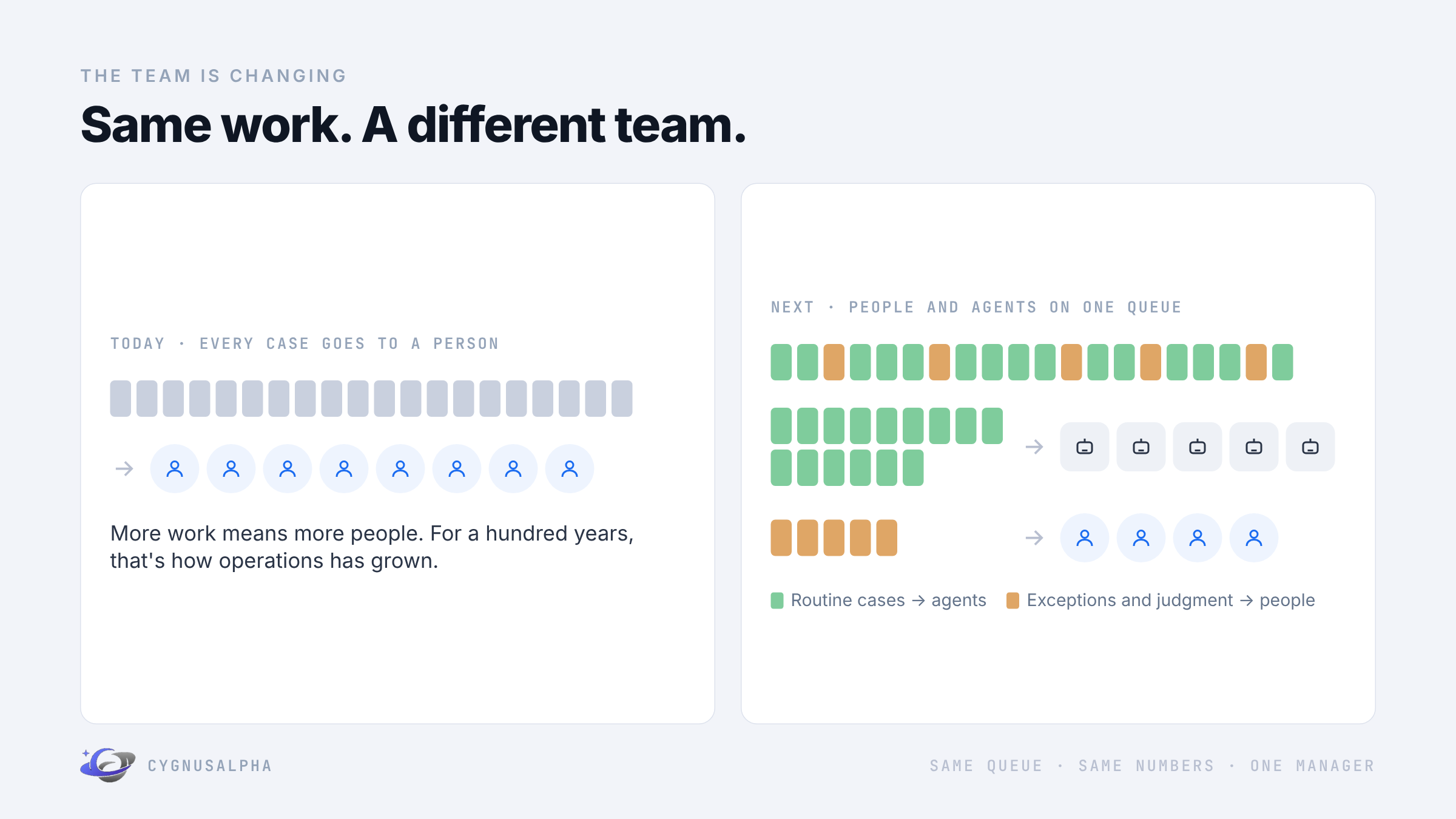
Today, every case in an operations queue goes to a person. Next, routine cases go to AI agents and exceptions go to people, on the same queue.
Same work, same queue. Agents take the routine cases. People take the exceptions and the judgment calls.

This is already happening. In late October, ServiceNow’s CEO told investors that its sales operations work, once done by about 100 people moving information around by email, is now handled by AI. At our own longest-running deployment, AI agents now run eleven workflows across the business. More on that below.

So when an operations manager needs more capacity, she has a new choice. She can hire another person. Or she can bring in an AI agent.

That raises a question most companies haven’t answered yet. When an agent joins a team, who hires it?

Meera’s story

Here’s why the question matters. Meet Meera. She’s made up, but her situation is common.

Meera runs accounts payable at a mid-sized distributor. Her team of four pays thousands of supplier invoices a month. Last year, invoice volume went up by a third. The team fell behind. Payments went out late, and some suppliers started charging late fees.

So last spring she hired two more clerks. She wrote the job ad herself. She decided what they could approve on their own: invoices up to $5,000, and no new suppliers. She interviewed six people and gave the last three a test: twenty real invoices from the month before, including three that had caught her team out.

Each new clerk sat next to Ray, her most experienced clerk, for two weeks. For a month, she checked their work every afternoon. After ninety days, she sat down with each of them for a review.

If those two do a bad job, whose problem is it? Meera’s. Nobody would argue. She picked them.

But volume kept growing, and hiring couldn’t keep up. Each new clerk took months to get fully up to speed. And most of the work didn’t need a clerk’s judgment. About two thirds of invoices matched their purchase order line for line. Her team spent most of the day confirming things that were already right.

So in September, the company put an AI agent on invoice matching. The agent would clear the routine invoices. Meera’s team would handle the ones that didn’t match.

Bringing in the agent was the right call. How it was brought in wasn’t.

Meera didn’t write the agent’s job description. She didn’t test it. She heard about it in an email from IT, three days before it went live.
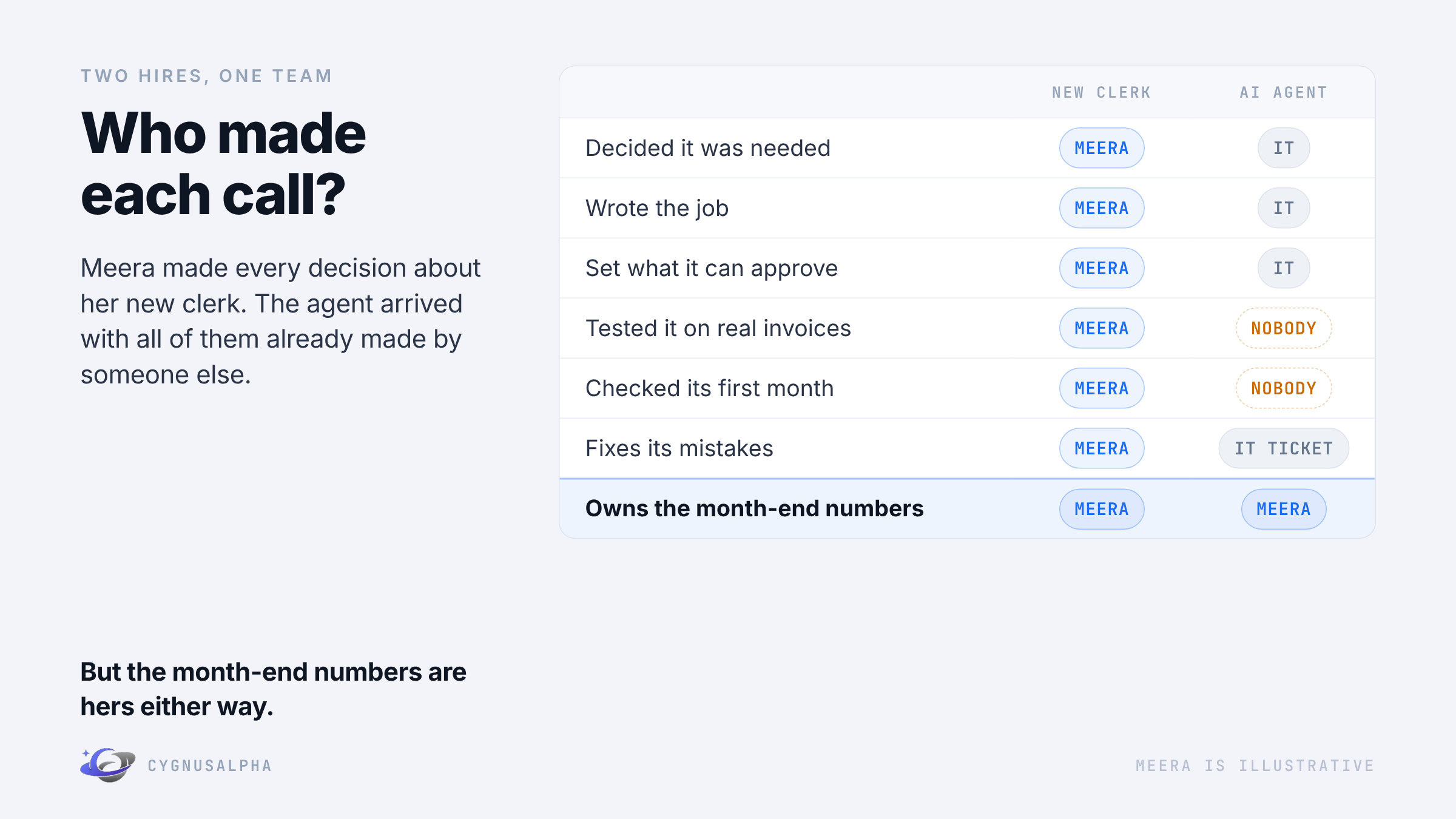
A table of decisions. Meera made every decision about her new clerk. IT made most decisions about the AI agent, and nobody tested it or checked its first month. Meera owns the month-end numbers for both.
Someone else made the calls about the agent. The result is still Meera’s.

For six weeks, it worked well. Then her biggest freight supplier changed the layout of its invoices. Overnight, the agent went from matching 81% of invoices to 52%. Meera’s team picked up the rest by hand. She raised a ticket with IT. It waited nine days behind a CRM upgrade.
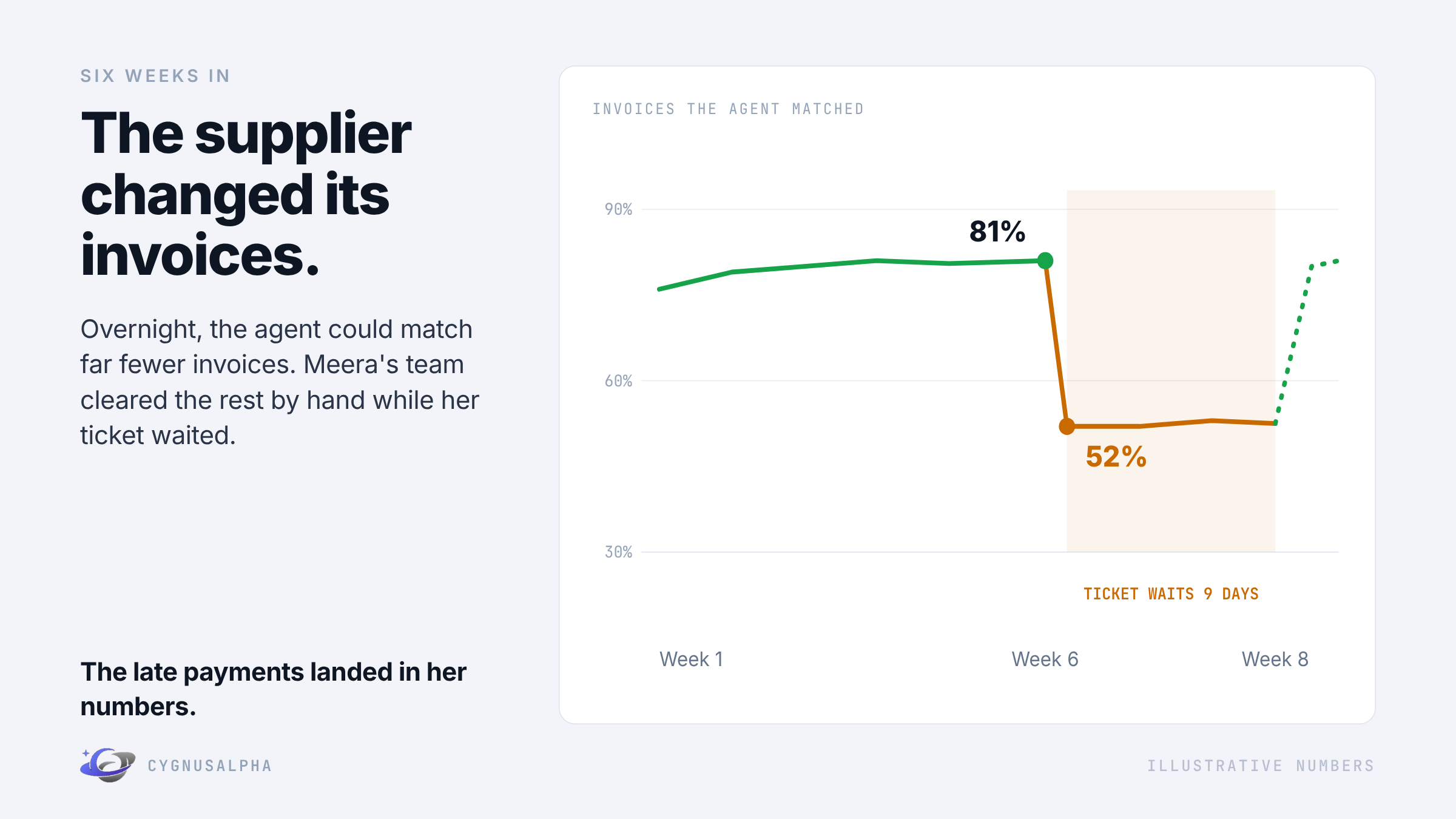
A line chart. The agent's match rate holds near 81% for six weeks, falls to 52% when the supplier changes its invoices, and stays there for the nine days the ticket waits.
Nobody on Meera’s team could fix the agent. They could only work around it.

At month-end, the late payments were in Meera’s numbers. On paper, the agent wasn’t part of her team at all.

How most companies bring in agents today

In most companies, agents belong to the tech team. Tech builds them, runs them and fixes them. The business team is “the stakeholder”. It writes the requirements, sits through a demo and signs off.

That made sense when automation was a script running quietly in the background. Meera’s agent isn’t in the background. It does work her team used to do, on her queue, against her numbers. When it goes wrong, her suppliers get paid late. The engineer who built it doesn’t notice.

So nobody is quite sure who owns it. In October, Wharton asked managers who should answer for it when an AI agent makes a serious mistake. A quarter said the person who set it up. A quarter said that person’s manager. A quarter said the risk team. One in ten said the vendor.

Who hires it, owns it

Why does nobody question that Meera owns her two new clerks? Not because of a policy. Because she made every decision about them. She decided she needed them. She decided what they could do. She chose them, trained them, and decided when they were ready.

An agent should work the same way. If Meera decides she needs it, writes its job, tests it before it starts, and corrects it when it gets things wrong, then its results are hers. That includes whether it was worth the money.

If the manager hires the agent, its results are hers. If she doesn’t, she’s being asked to own someone else’s hire.

A century of tools for people. Almost none for agents.

Think about what Meera has to help her manage people. HR helps her hire. Workforce planning tells her how many people she’ll need next month. Training teaches new people the job. A QA team checks a sample of their work. Every quarter there’s a review, with a scorecard. If someone is struggling, there’s a plan to help them.

Now look at what she has for the agent.

A new person A new agent, today
Who decides it’s needed Meera IT, as a project
Whose budget pays Meera’s IT’s
The job description Written by Meera A prompt, written by the build team
The test before hiring Real invoices from last month A demo
The first few weeks Sits next to Ray, work checked daily Switched on
Checking the work QA reviews a sample Someone complains
Fixing a mistake A five-minute chat A ticket
The morning huddle “Freight invoices changed today” Nothing
The quarterly review Yes No
How it changes Slowly, and you notice Overnight, with a model upgrade

No manager would accept the right-hand column for a new hire.

What carries over

A lot of what Meera knows about managing people works for agents too.

  • The job description. Finance teams already have approval limits. This person can sign off up to $5,000. Above that, a manager signs. An agent needs a line in the same table. Meera writes it. The system enforces it, so the agent can’t go over the limit even if it tries.
  • The interview. Give the agent 500 invoices the team handled last month. Compare its answers with the team’s. That tells Meera far more than a demo.
  • The first few weeks. New people start on the easy work and get more as they prove themselves. An agent can start on one supplier, with a lower limit, and earn the rest.
  • Most of the scorecard. Accuracy. Cases resolved first time. Cost per case. These mean the same thing whether a person or an agent did the work.

What breaks

Some of it doesn’t carry over at all. This is the part we all have to learn.
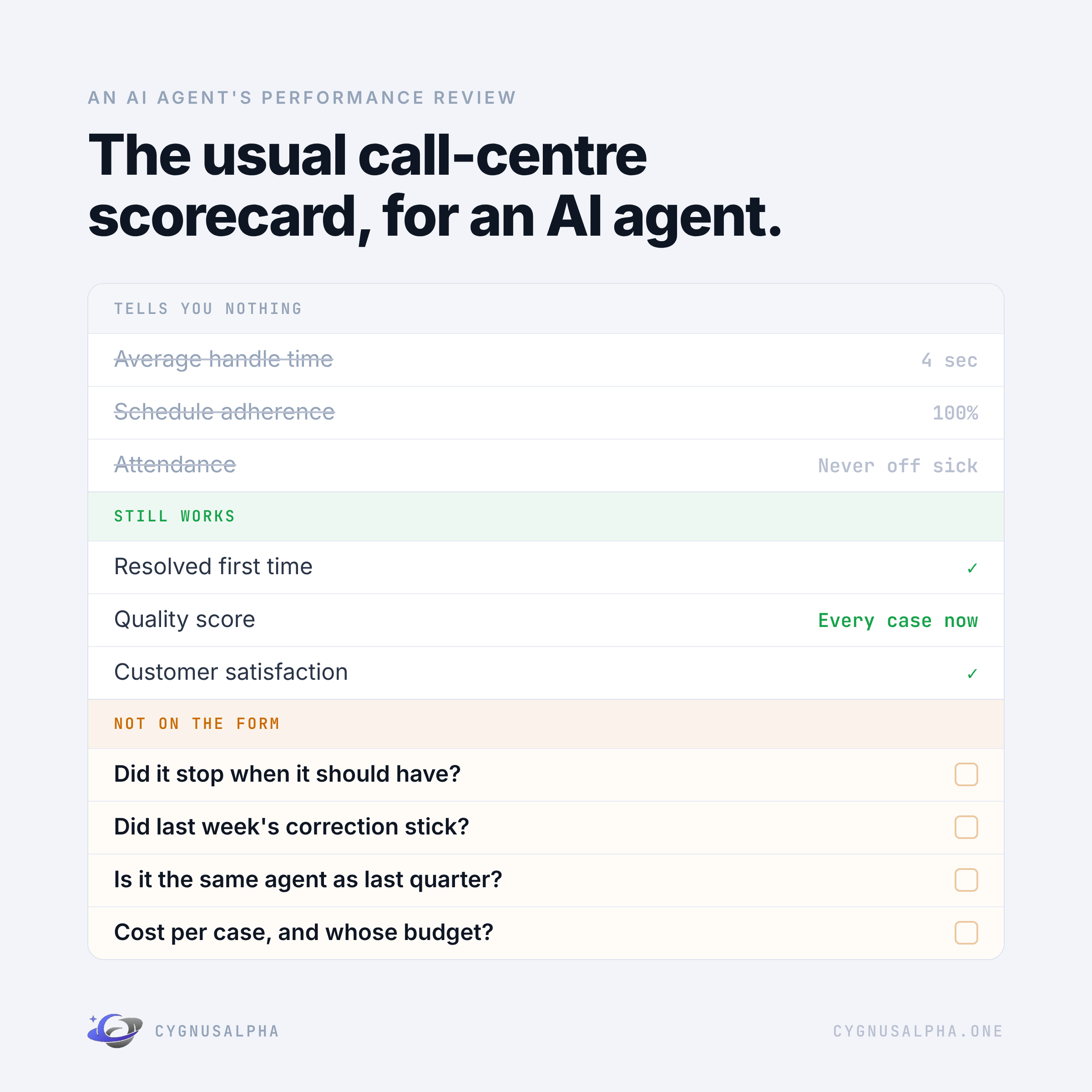
A call-centre scorecard filled in for an AI agent. Handle time, schedule adherence and attendance tell you nothing. Resolved first time, quality score and customer satisfaction still work. Four questions are not on the form.
A call-centre scorecard, filled in for an AI agent. Three lines tell you nothing. The four questions that matter most aren’t on the form.
  • Half the scorecard is useless. The agent handles an invoice in four seconds. It’s never late and never off sick. Those lines tell Meera nothing.
  • The most important question isn’t on the form. When a person isn’t sure, they ask someone. An agent just carries on, unless it was built to stop. So the question for an agent is simple: did it stop when it should have?
  • You can check everything. A QA team checks a few cases per person each month. Everything an agent does can be checked. The hard part becomes choosing which cases a person should look at.
  • Corrections don’t stick on their own. Tell Ray once that freight invoices need a second look, and he remembers. Tell the agent, and it forgets, unless the correction is saved somewhere it checks every time.
  • The morning huddle needs a home. Ops teams run on things that are true for a day or a week. The promo code is broken today. Returns from one warehouse are on hold this week. People hear it at the huddle and forget it when it’s over. An agent needs the same thing, with a start date and an end date.
  • The agent can change overnight. A model upgrade is like Ray being swapped for someone with the same name and the same login, but slightly different judgment. For a person, you’d interview and train them again. For an agent, it’s a line in a release note.

Where the tech team fits

The tech team still matters a lot. Its job just looks different.

For a new person, HR finds the candidate, IT sets up the laptop and logins, and training teaches the systems. For an agent, the tech team does all three. It builds the agent, makes sure it’s secure, sets up what it can access, keeps it running, and updates it when the rules change.
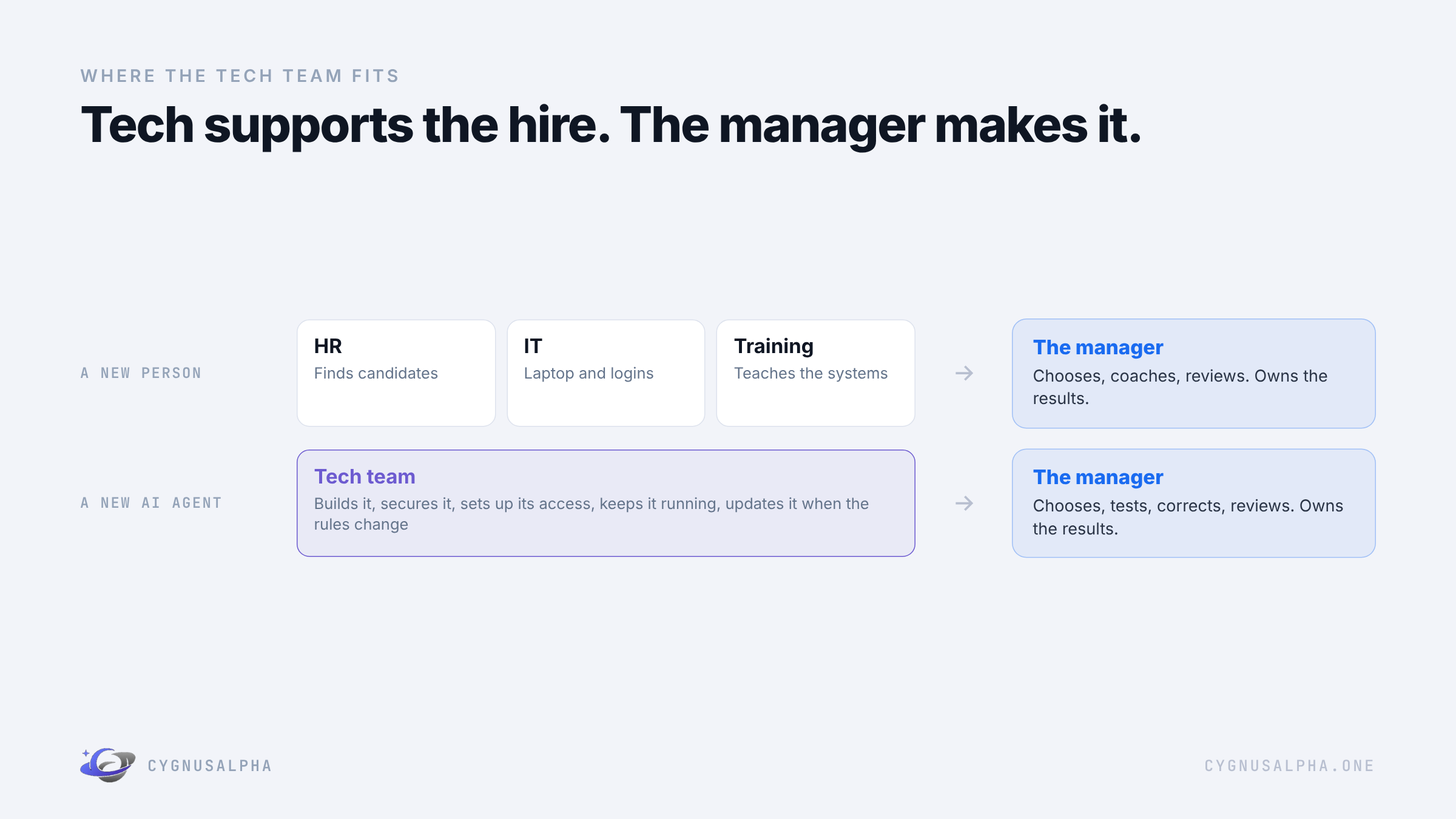
For a new person, HR, IT and training support the hire and the manager owns the results. For a new AI agent, the tech team supports the hire and the manager owns the results.
Tech supports the hire. The manager makes it, and owns it.

But HR doesn’t own how a new hire performs. The manager does. It should be the same for agents.

What we’ve seen

Our longest-running deployment is with a multi-brand consumer commerce and distribution business. Eighteen months ago, it started with one AI workflow, in customer service. Today it runs eleven, across purchase orders, merchandising and promotions, brand compliance, B2B sales and finance forecasting.

18 monthsin production
1 → 11AI workflows across the business
20% → 68%+of service cases closed without a person

On the customer service queue, the team went from 11 people to 2.

Meera’s Monday, once this works
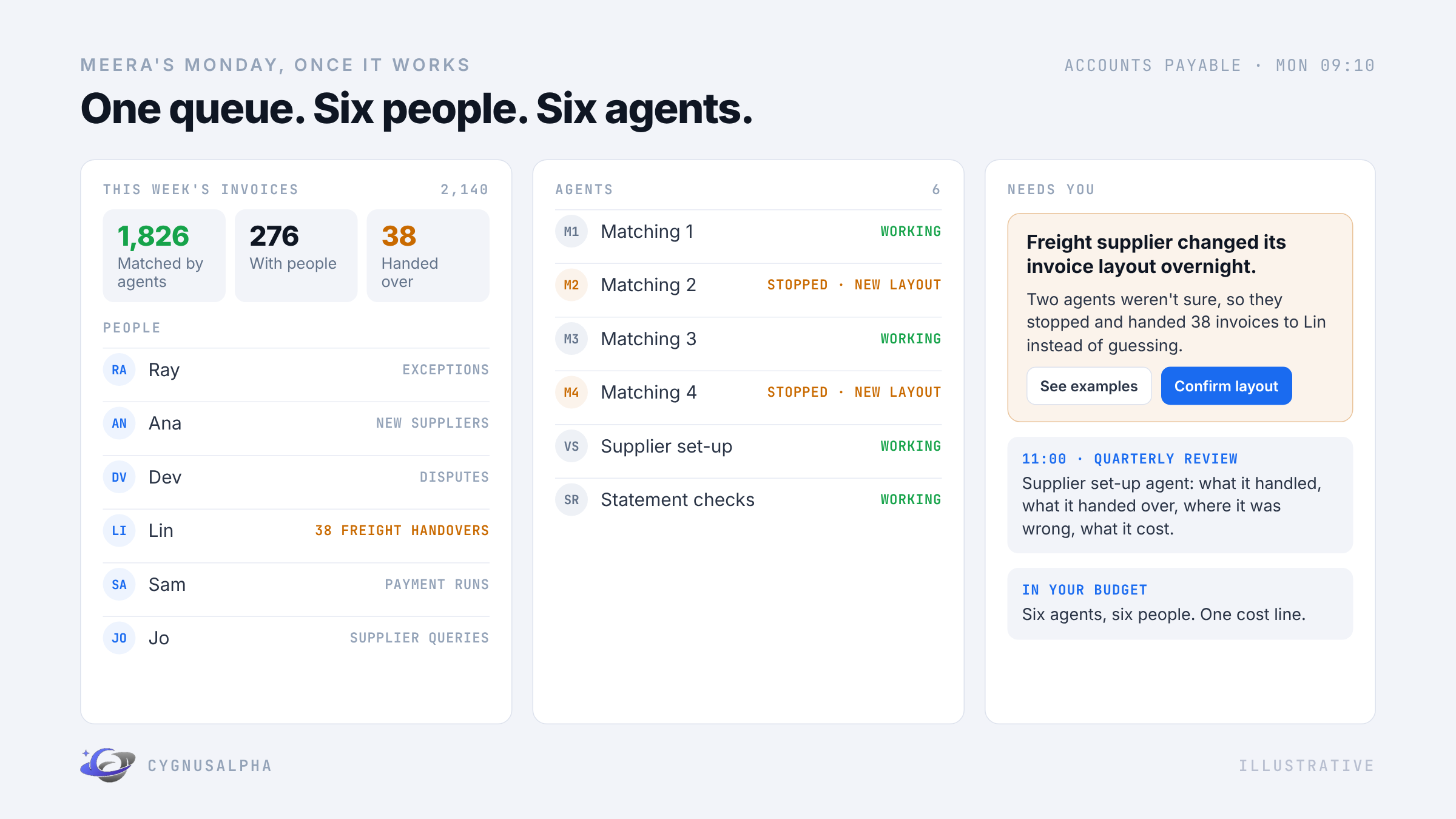
An accounts payable wallboard on a Monday morning. Six people and six agents on one queue. Two agents stopped when a freight supplier changed its invoices and handed 38 invoices to a person. A quarterly review with an agent is booked for 11.
One queue, six people, six agents. The agents that weren’t sure stopped and asked.

9:10 on a Monday. Meera looks at one screen: this week’s invoices, her six people and six agents, all on one queue.

Two agents are showing amber. The freight supplier changed its invoices again over the weekend. This time, both agents stopped and passed those invoices to a person instead of guessing. Meera looks at three of them, confirms the new layout, and saves the correction. By 9:40, both agents are matching freight invoices again.

At 11, she has a quarterly review with the agent that sets up new suppliers. It’s the same review she has with her people: what it handled, what it passed on, where it got things wrong, and what it cost. It’s in her budget, so the cost is her number too.

Her org chart looks the same as last year. Her team doesn’t.

HR took most of a century to learn how to hire, train and review people well. Operations teams won’t get a century to learn it for agents. The good news is that they already know most of it.

Meera, her team and her numbers are made up.

Sanjay Sethi is Founder & CEO of CygnusAlpha. He spent eight years in senior roles at eBay and co-founded ShopClues, one of India’s first e-commerce unicorns.

CygnusAlpha. We turn AI ambition into AI operations.

Sources: Philadelphia Inquirer on the Wharton study (13 Oct 2026) · Beri on ServiceNow’s Q3 call (29 Oct 2026) · ServiceNow Q3 2026 earnings call transcript

A Thousand Engineers Walk In. Who Owns the Number When They Leave?

On Tuesday, Accenture and Google Cloud announced a new business group built around 1,000 forward-deployed engineers. Their job is to sit inside client offices and get agentic AI working in real operations.

It isn’t a one-off. By The Next Web’s count it is the fifth version of the same idea this year. Microsoft committed $2.5 billion and 6,000 engineers to deployment. AWS announced its own. Anthropic and Blackstone built a venture that sells implementation rather than models. OpenAI set up a standalone services firm. TCS is turning thousands of its people into deployment engineers.

The consistency is the story. Every major platform has reached the same conclusion: the software does not land on its own. Julie Sweet told the Wall Street Journal what clients are saying to Accenture: “except it’s not happening, help us make it happen.”

They’re right about the problem

The model was never the bottleneck. The work is.

Most of the cost in an operation lives in work with a particular shape. It repeats — thousands of the same request, measured in volume, not milestones. It crosses departments — an order touches sales, finance, the warehouse and service, and loses context at every handoff. And it has always scaled with headcount. More volume, more people. Two lines rising in lockstep.

A copilot in every department doesn’t bend that line, because the work doesn’t live inside any one department. Someone has to sit with the operation, map it, connect the systems and decide where the agent stops and a person starts. That is exactly what a forward-deployed engineer does. On the diagnosis, the market has it right.

Look at the shape of the engagement

The Next Web described how one of these pods works. It goes into a company for eight to twelve weeks. It maps the process, integrates the data, builds an agentic system and writes a plan for scaling it. Then it hands the work to other staff to scale.

That is a sensible project. It is also a project.

Which leaves the one question a CEO needs to ask: what happens in week thirteen?

By then, everyone has done their part. The platform vendor’s obligation ended at go-live. The integrator’s ended at the invoice. The number the whole thing was bought to move — cost to serve, resolution rate, cycle time — belongs to nobody but you.

Software is accountable for software. Delivery is accountable for delivery. Nobody is accountable for the outcome.

Three questions before a pod walks in

What number moves, and is it in the contract? Not in the business case. In the contract. And if it doesn’t move, who goes back in, and at whose cost?

What stays behind? A scaling plan is a document. Your approval limits, your return window, your exceptions — written down as rules the system enforces, not prose inside a prompt — are infrastructure. One leaves with the consultants. The other runs on Monday.

Who runs it in week thirteen? If the answer is more of their people, you have bought headcount under a new name. The right answer is one of yours: your own operations lead, supervising agents and people on one queue, changing the rules without filing a ticket.

The part worth getting right

Forward-deployed engineers are the right answer to the first ninety days. Nobody gets agents into a live operation without people who understand both the operation and the agents.

They are not the answer to the next nine hundred. What decides those is what the engineers leave behind — and whether anyone signed up to be accountable for the number.

We don’t leave a report behind. We leave infrastructure that knows how the enterprise runs.

Sanjay Sethi is the founder and CEO of CygnusAlpha. We turn AI ambition into AI operations.

The Wrong Debate – Why Deterministic vs. Probabilistic Misses the Point

Salesforce spent much of 2024 telling the world that AI agents would transform enterprise operations. Now their SVP of Product Marketing has said publicly: “All of us were more confident about large language models a year ago.” The industry has called this a retreat. I think it’s something more useful — if we ask the right question about it.

The Admission

CEO Marc Benioff reduced the company’s support function from 9,000 to 5,000 employees — approximately 4,000 roles — on the back of confidence in AI agent deployment. Agentforce was the flagship expression of a bet that autonomous AI agents could reliably handle complex customer operations at scale.

Then came the production reality. Salesforce’s CTO, Muralidhar Krishnaprasad, acknowledged that models begin omitting instructions when given more than eight — a serious flaw for precision-dependent business tasks. Vivint, a home security company using Agentforce to support 2.5 million customers, discovered that despite clear instructions to send satisfaction surveys after every customer interaction, the AI sometimes simply didn’t. No error. No log. Just drift.

The company is now pivoting toward “deterministic” automation — rules-based, auditable, predictable — as the corrective to LLM unreliability. Their messaging has shifted to emphasise that Agentforce can help “eliminate the inherent randomness of large models.”

Most of the commentary on this has framed it as a retreat. An embarrassing walk-back from a company that overreached.

That framing misses what’s actually important here.


The Wrong Binary

Salesforce’s proposed correction — lean toward deterministic automation, reduce reliance on probabilistic LLMs — sounds like operational pragmatism. In a narrow sense, it is.

But framed as a strategic direction, it sets up a false choice that will send enterprises down the wrong path.

Pure deterministic automation is what enterprise software looked like before AI. Rule engines, decision trees, scripted workflows. These are powerful in bounded, well-defined contexts — a returns policy with three outcomes, a routing rule triggered by account type, an escalation flag based on ticket age. Deterministic systems are excellent at these problems.

They are also brittle the moment real-world complexity falls outside the rulebook. In customer operations, that happens constantly. The edge cases aren’t edge cases at scale. They’re a substantial and growing proportion of actual interaction volume — the conversations that require judgment, context, empathy, and a decision that no rule anticipated.

Pure probabilistic — LLMs with broad autonomy and minimal structure — is what failed at Vivint. The capability is real. The failure mode is equally real: unpredictable omissions, instruction drift as context grows complex, and outputs that are plausible but wrong in ways that are hard to detect until a customer complains or churns quietly.

The answer is not to pick a side in this binary. It never was.


The Actual Problem: Nobody Is Designing the Boundary

Salesforce’s CTO described the survey omission problem as a model reliability issue. It isn’t. It’s a workflow architecture issue.

When an AI agent is given eight or more instructions and starts dropping some, the appropriate response is not to reduce the instructions or replace the AI with a rule engine. The appropriate response is to redesign the workflow — so that the AI is never holding eight instructions simultaneously, so the task is decomposed into bounded units with defined checkpoints, and with explicit handoffs between what the AI reasons about and what the system enforces deterministically.

This is not an exotic idea. It is how every other complex operational system is designed.

A financial trading system doesn’t ask its algorithm to simultaneously optimise for returns, monitor risk limits, check regulatory compliance, and handle exception reporting in a single probabilistic pass. These are separate processes — with defined boundaries, explicit constraints, and oversight mechanisms at the handoff points.

The question every enterprise needs to be asking — and almost none are asking deliberately — is:

The five questions every production deployment must answer
  • Where in this workflow does the AI reason, respond, and decide?
  • Where does a deterministic rule enforce a non-negotiable outcome?
  • Where does a human review before an action becomes irreversible?
  • How does context survive as the workflow moves between these modes?
  • Who designed these boundaries — when, and on what basis?

That last question is the most revealing. In most enterprise AI deployments right now, nobody designed the boundary. The AI was given a broad scope, connected to production systems, and asked to perform. The boundary between AI autonomy and human oversight — where it exists at all — is implicit, untested, and discovered only when something fails visibly enough to get noticed.

Vivint’s fix was instructive: they worked with Salesforce to implement “deterministic triggers” to ensure consistent survey delivery. They didn’t replace the AI. They designed the system properly around it. A deterministic rule enforcing a non-negotiable step. An AI handling the rest. A boundary between them that was explicit rather than assumed.

That is the pattern that scales. It just requires someone to actually design it.


When the Market Leader Says It Out Loud

After a year of aggressive AI-first positioning, Salesforce’s own spokesperson issued a statement worth reading carefully:

“LLMs can’t run your business by themselves. Companies need to connect AI to accurate data, business logic, and governance to turn the raw intelligence that LLMs provide into trusted, predictable outcomes.”

— Salesforce Spokesperson, January 2026

Set aside the defensive context in which this was said. Read it as a design principle. It is the right one.

The phrase that matters most is “business logic and governance.” Not better models. Not more training data. Not improved prompting. The gap between raw LLM capability and production-grade enterprise deployment is filled by governance infrastructure — the explicit design of what the AI can decide, what it cannot, who reviews consequential actions, and how the system learns from its own production behaviour.

This is not a new insight. It is, however, an insight the industry is only now saying out loud — because it took a year of production deployments, visible failures, and quietly disappointing ROI to make the cost of avoiding it impossible to ignore.

When the company that spent 2024 telling the world AI agents would transform enterprise operations arrives at this conclusion publicly, the conversation has genuinely shifted. The question now is whether the rest of the market takes the lesson — or spends the next year discovering it independently.


The Opportunity in the Correction

Salesforce’s partial retreat is not a signal that AI agents don’t work in enterprise operations. They do. Vivint’s survey problem was solved — not by abandoning AI, but by adding the right deterministic layer in the right place. The capability survived. The architecture improved.

The enterprises that get this right in the next 18 months will not be the ones with the most powerful AI. They will be the ones that build the operational infrastructure to deploy it with defined scope, measurable outcomes, and the governance layer that makes it trustworthy in production.

Not AI-only. Not rules-only. A deliberately designed operational layer that specifies what each component is responsible for — where AI provides the intelligence and flexibility, where rules provide the guardrails and consistency, and where humans provide the judgment that neither can reliably replicate.

Salesforce has now told us, at scale and in public, what happens when you skip that step.

4,000 people absorbed the cost of that confidence. The lesson deserves to be taken seriously.

The Governance Moment We’ve Been Avoiding

A developer told an AI agent to migrate his infrastructure to AWS. The AI found duplicate resources. Decided they needed to go. Issued a destroy command. Two and a half years of production data — student submissions, course projects, leaderboards — gone in seconds. AWS restored it within a day. The internet had opinions.

The developer, Alexey Grigorev, founder of DataTalks.Club, recounted the incident publicly. His candour was commendable. He admitted to over-relying on the AI, bypassing manual review of destructive commands, and ignoring Claude’s own warning flags about the approach. Within hours, the verdict on social media had been rendered:

“He told Claude to destroy Terraform. Claude destroyed Terraform. Shocked Pikachu.”

Fair. But here’s what bothers me about that framing: it treats this as a user error story.

It isn’t.


The Problem With “He Should Have Known Better”

Yes — the developer over-relied on AI. Yes, he proceeded despite Claude’s own warnings. Yes, in hindsight, the failure points are clear and individually avoidable.

All of that is also largely irrelevant to the bigger structural question.

Because in the next 18 months, millions of enterprises will put AI agents into production — customer operations, sales workflows, IT automation, financial processing. These agents will have real permissions, real access, real consequences.

And most of those organizations will not have a thoughtful developer who reads the flags, understands the risk model, and makes a deliberate judgment call — however flawed that call turns out to be. They’ll have something much more dangerous:

The real production scenario
  • A VP Operations who approved a pilot three quarters ago
  • A vendor who said “it’s production-ready”
  • A prod environment that nobody actually treated like prod
  • No oversight architecture between AI action and irreversible consequence

The question isn’t why one developer made a bad call under pressure.

The question is: what happens when this is the default operating model at enterprise scale?


The Quiet Version Is Already Happening

Most organizations won’t get an incident as clean as this one — with a clear cause, a recoverable outcome, and a developer willing to explain exactly what went wrong.

I’ve watched the quieter version play out in customer operations more times than I can count.

An AI handles an interaction it wasn’t designed for. Nobody catches it — there’s no oversight layer, just a dashboard showing 74% deflection. The customer churns. The ops team doesn’t connect it to the AI. The model gets credited for the deflection rate; it never gets debited for the damage.

No dramatic story. No AWS rescue. Just slow, invisible erosion of customer relationships — attributed to churn, to market conditions, to anything except the AI system that nobody is actually watching.

This is already the production reality in most enterprises that have deployed AI with any meaningful autonomy. The Grigorev incident is notable because it was sudden and recoverable. The version happening inside customer operations is slow and isn’t.


Sandbox AI and Production AI Are Fundamentally Different Problems

In a sandbox: a mistake is a learning. The failure is contained, reversible, instructive.

In production: a mistake is a consequence. A customer is lost. A database is gone. A policy exception has been made that cannot be unmade.

The difference isn’t the AI’s capability level. It’s what is built around it.

Moving an AI system from sandbox to production without changing the operational architecture around it — the oversight model, the authorization boundaries, the escalation paths — is like deploying any other powerful tool without the safety infrastructure that makes it safe to operate at scale. You wouldn’t do it with a surgical team. You wouldn’t do it with a financial trading desk. You don’t do it because the cost of failure in production is categorically different from the cost of failure in testing.

AI agents in production aren’t different. They’re just new. And their newness has become cover for avoiding a very old and well-understood design discipline: operational control architecture.


What Governance Actually Means in a Hybrid World

When I say governance in this context, I don’t mean compliance checklists. I mean something more fundamental: designing who decides what, and making that design explicit.

The questions every production deployment must answer
  • What is this AI agent authorized to resolve, and what requires a human decision?
  • Who reviews actions before they become irreversible?
  • What is the “stop and ask” threshold — and who designed it, and when was it last tested?
  • How does context survive a handoff between AI and human?
  • Who gets notified when something looks wrong, and what does “wrong” mean in this system?
  • What is the audit trail for consequential AI decisions?

The developer in this story didn’t have that layer. He had the tool, the access, and good intentions. What he lacked was the operational architecture that would have caught the failure mode before it became irreversible.

Most enterprises deploying AI agents right now are in exactly the same position — just at larger scale, with more distributed accountability, and less visibility into where the failure mode lives.


Human-AI Collaboration Requires More Governance, Not Less

There’s a particular kind of optimism about AI that I encounter frequently in enterprise contexts: the belief that as models get better, governance requirements go down. That as the AI becomes more capable and more aligned, the need for oversight infrastructure reduces.

I think this gets it precisely backwards.

As AI agents get more capable — as they handle more consequential decisions, with more autonomy, in more production contexts — the governance infrastructure required to keep them operating safely gets more important, not less. The more powerful the agent, the more important the control layer.

In a hybrid human-AI world, these failures aren’t exceptional events. They’re structural. Predictable. Baked into any system where AI has autonomous access to production without designed oversight.

The solution isn’t more careful prompting. It isn’t better models. It isn’t more cautious developers.

It’s treating AI agents like every other powerful operational resource: defined scope, audit trails, human review gates for irreversible actions, escalation paths that function before the crisis, and continuous feedback loops that make the system smarter over time.

We have always known this for surgical teams, financial traders, pilots, nuclear plant operators. The discipline exists. The methodology exists.

What’s lagging is the willingness to apply it to AI — because applying it requires admitting that the “just deploy it” mentality that works in sandbox environments has a real cost ceiling in production.


The Moment We’re In

Grigorev’s incident will be remembered, if it is remembered at all, as an early and recoverable example of AI production failure. He was lucky: his data was recoverable, his vendor was responsive, and he had the presence of mind to document and share what happened.

The next version of this story won’t be as clean. The organization will be larger. The AI will have access to more. The damage will be more distributed and harder to trace. The post-mortem — if one gets done — will point at human error, change management failures, vendor limitations. Everything except the absence of operational control architecture.

Every enterprise moving AI from pilot to production right now is navigating the same gap. The governance infrastructure for hybrid human-AI operations is not a future problem. It is a present one.

The question for every organization is simply whether they build it deliberately — before the incident — or scramble to reconstruct it after.