Walk onto the operations floor of any large company. Accounts payable is matching invoices to purchase orders. Customer service is answering “where is my order?” Order management is chasing late shipments. Claims is checking forms against policies.
This is where most of a company’s people work. It’s the same task, thousands of times a week. And for a hundred years, this work has grown in only one way: more work, more people.
That is starting to change.
A new kind of team member
AI agents can now do a big share of the routine part of this work. An agent can match an invoice that lines up with its purchase order. It can tell a customer where their parcel is. It can check a claim form for missing fields.
It can’t do all of it. The odd cases, the disputes and the judgment calls still need people. So operations teams won’t become all AI. They’ll become mixed: people and agents working the same queue, measured on the same numbers.
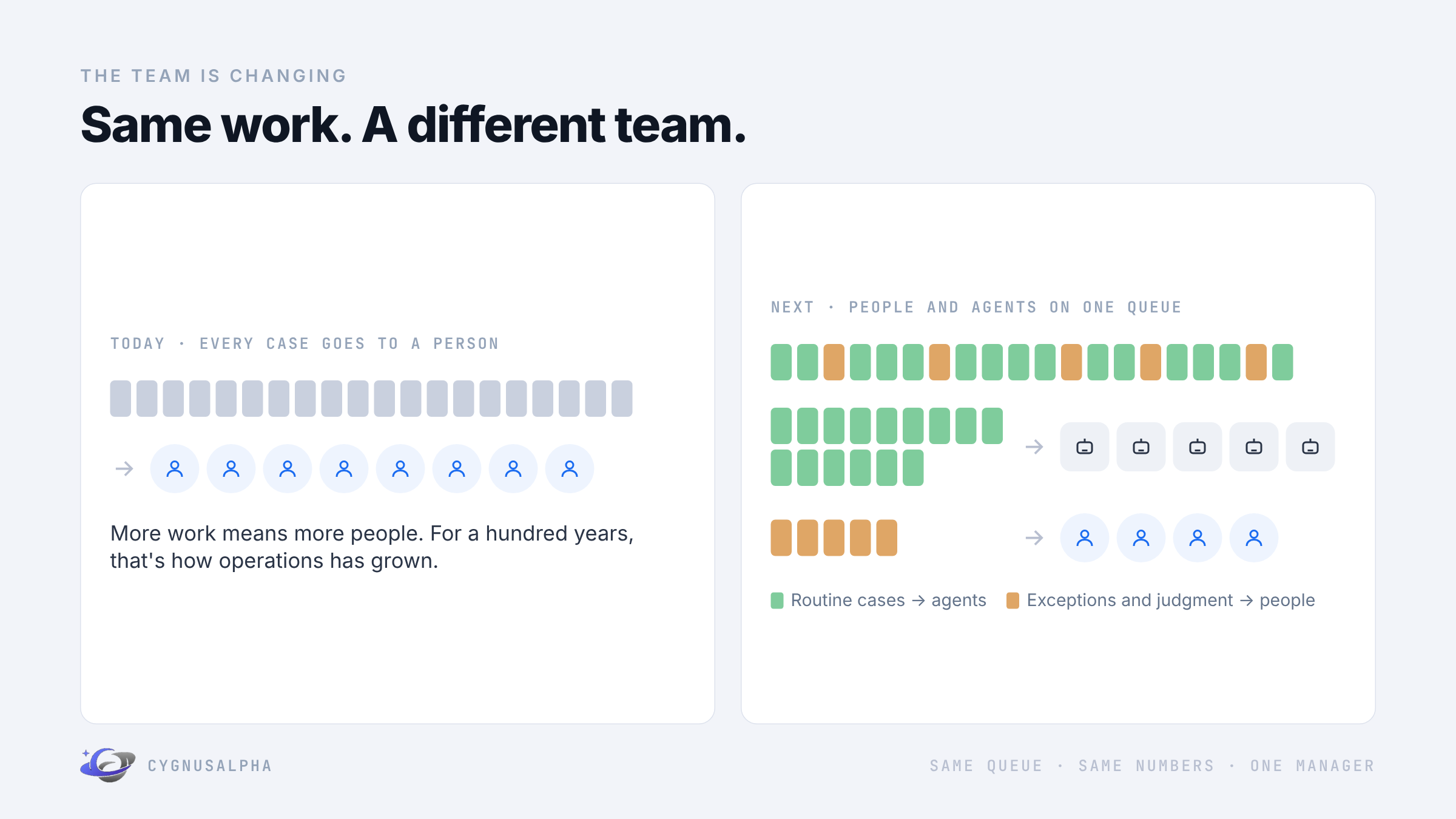
This is already happening. In late October, ServiceNow’s CEO told investors that its sales operations work, once done by about 100 people moving information around by email, is now handled by AI. At our own longest-running deployment, AI agents now run eleven workflows across the business. More on that below.
So when an operations manager needs more capacity, she has a new choice. She can hire another person. Or she can bring in an AI agent.
That raises a question most companies haven’t answered yet. When an agent joins a team, who hires it?
Meera’s story
Here’s why the question matters. Meet Meera. She’s made up, but her situation is common.
Meera runs accounts payable at a mid-sized distributor. Her team of four pays thousands of supplier invoices a month. Last year, invoice volume went up by a third. The team fell behind. Payments went out late, and some suppliers started charging late fees.
So last spring she hired two more clerks. She wrote the job ad herself. She decided what they could approve on their own: invoices up to $5,000, and no new suppliers. She interviewed six people and gave the last three a test: twenty real invoices from the month before, including three that had caught her team out.
Each new clerk sat next to Ray, her most experienced clerk, for two weeks. For a month, she checked their work every afternoon. After ninety days, she sat down with each of them for a review.
If those two do a bad job, whose problem is it? Meera’s. Nobody would argue. She picked them.
But volume kept growing, and hiring couldn’t keep up. Each new clerk took months to get fully up to speed. And most of the work didn’t need a clerk’s judgment. About two thirds of invoices matched their purchase order line for line. Her team spent most of the day confirming things that were already right.
So in September, the company put an AI agent on invoice matching. The agent would clear the routine invoices. Meera’s team would handle the ones that didn’t match.
Bringing in the agent was the right call. How it was brought in wasn’t.
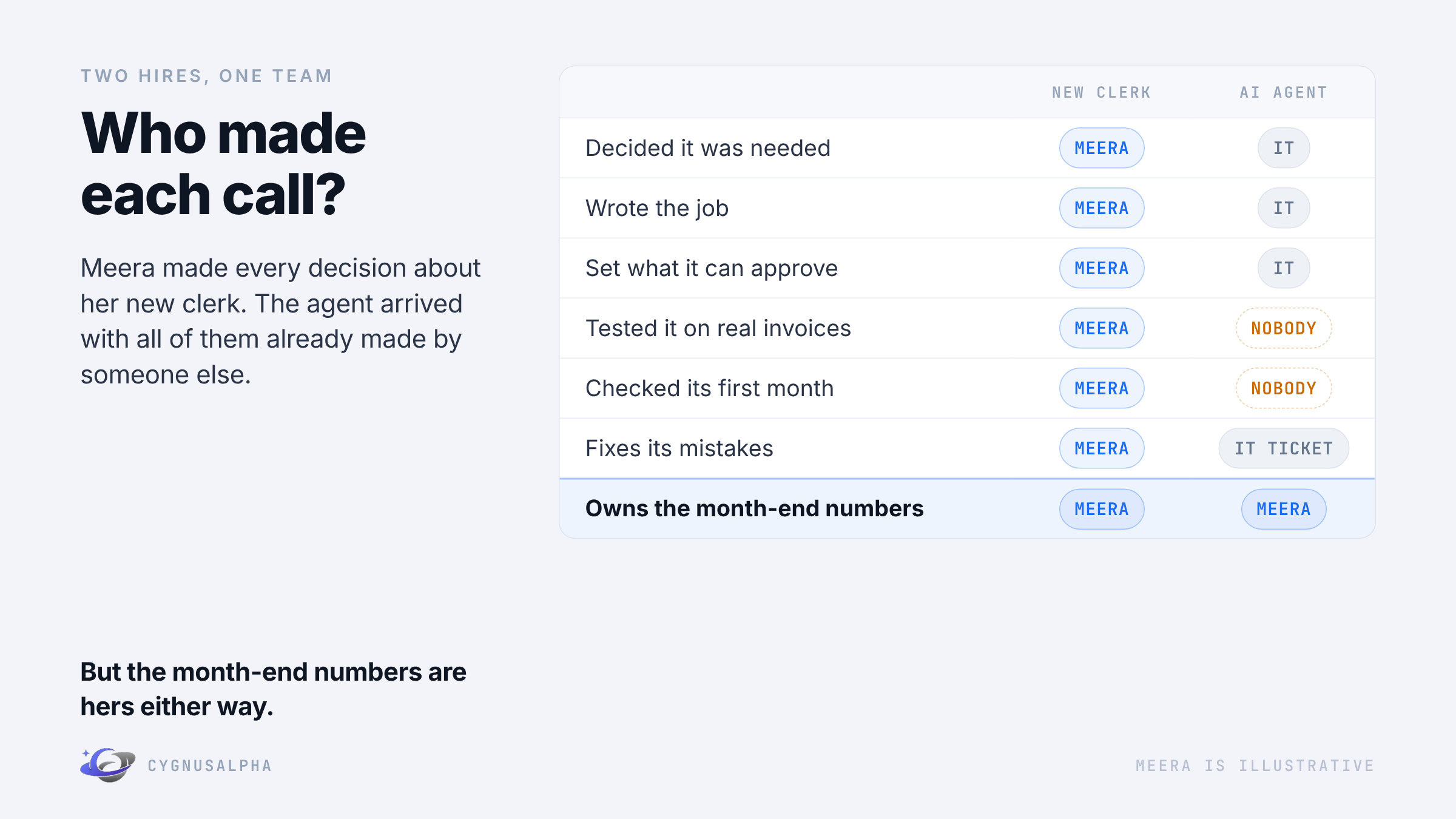
Meera didn’t write the agent’s job description. She didn’t test it. She heard about it in an email from IT, three days before it went live.
For six weeks, it worked well. Then her biggest freight supplier changed the layout of its invoices. Overnight, the agent went from matching 81% of invoices to 52%. Meera’s team picked up the rest by hand. She raised a ticket with IT. It waited nine days behind a CRM upgrade.
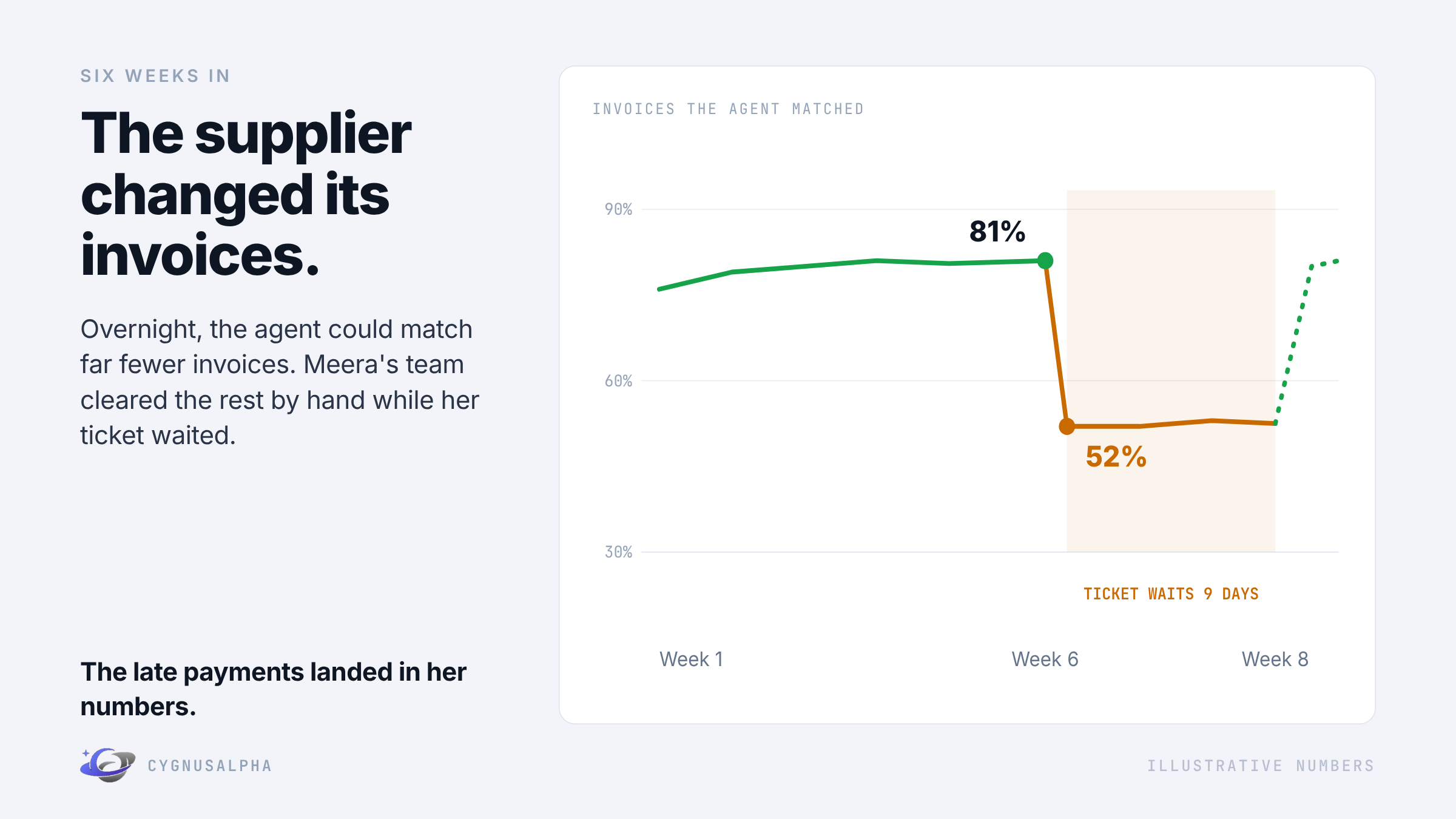
At month-end, the late payments were in Meera’s numbers. On paper, the agent wasn’t part of her team at all.
How most companies bring in agents today
In most companies, agents belong to the tech team. Tech builds them, runs them and fixes them. The business team is “the stakeholder”. It writes the requirements, sits through a demo and signs off.
That made sense when automation was a script running quietly in the background. Meera’s agent isn’t in the background. It does work her team used to do, on her queue, against her numbers. When it goes wrong, her suppliers get paid late. The engineer who built it doesn’t notice.
So nobody is quite sure who owns it. In October, Wharton asked managers who should answer for it when an AI agent makes a serious mistake. A quarter said the person who set it up. A quarter said that person’s manager. A quarter said the risk team. One in ten said the vendor.
Who hires it, owns it
Why does nobody question that Meera owns her two new clerks? Not because of a policy. Because she made every decision about them. She decided she needed them. She decided what they could do. She chose them, trained them, and decided when they were ready.
An agent should work the same way. If Meera decides she needs it, writes its job, tests it before it starts, and corrects it when it gets things wrong, then its results are hers. That includes whether it was worth the money.
If the manager hires the agent, its results are hers. If she doesn’t, she’s being asked to own someone else’s hire.
A century of tools for people. Almost none for agents.
Think about what Meera has to help her manage people. HR helps her hire. Workforce planning tells her how many people she’ll need next month. Training teaches new people the job. A QA team checks a sample of their work. Every quarter there’s a review, with a scorecard. If someone is struggling, there’s a plan to help them.
Now look at what she has for the agent.
| A new person | A new agent, today | |
|---|---|---|
| Who decides it’s needed | Meera | IT, as a project |
| Whose budget pays | Meera’s | IT’s |
| The job description | Written by Meera | A prompt, written by the build team |
| The test before hiring | Real invoices from last month | A demo |
| The first few weeks | Sits next to Ray, work checked daily | Switched on |
| Checking the work | QA reviews a sample | Someone complains |
| Fixing a mistake | A five-minute chat | A ticket |
| The morning huddle | “Freight invoices changed today” | Nothing |
| The quarterly review | Yes | No |
| How it changes | Slowly, and you notice | Overnight, with a model upgrade |
No manager would accept the right-hand column for a new hire.
What carries over
A lot of what Meera knows about managing people works for agents too.
- The job description. Finance teams already have approval limits. This person can sign off up to $5,000. Above that, a manager signs. An agent needs a line in the same table. Meera writes it. The system enforces it, so the agent can’t go over the limit even if it tries.
- The interview. Give the agent 500 invoices the team handled last month. Compare its answers with the team’s. That tells Meera far more than a demo.
- The first few weeks. New people start on the easy work and get more as they prove themselves. An agent can start on one supplier, with a lower limit, and earn the rest.
- Most of the scorecard. Accuracy. Cases resolved first time. Cost per case. These mean the same thing whether a person or an agent did the work.
What breaks
Some of it doesn’t carry over at all. This is the part we all have to learn.
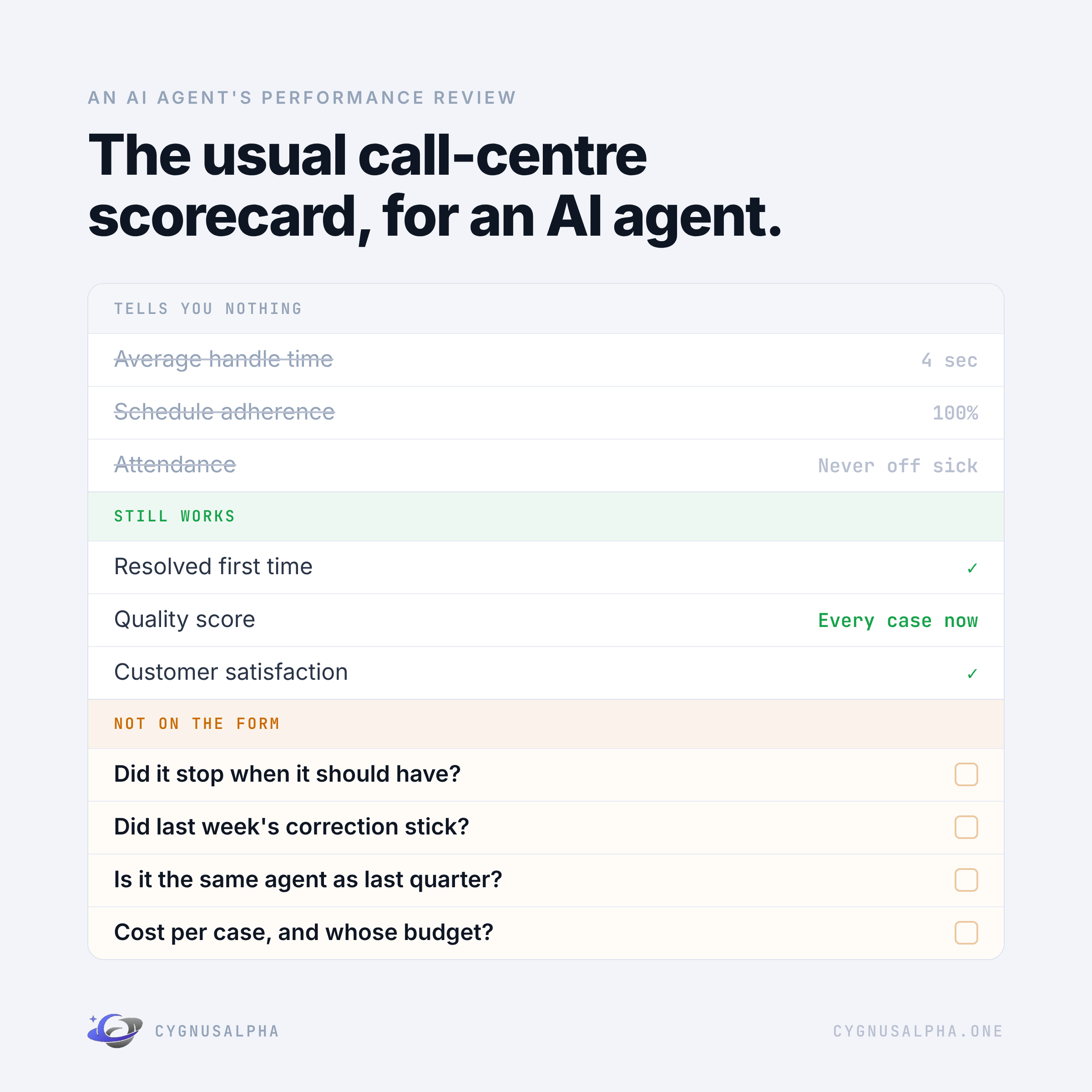
- Half the scorecard is useless. The agent handles an invoice in four seconds. It’s never late and never off sick. Those lines tell Meera nothing.
- The most important question isn’t on the form. When a person isn’t sure, they ask someone. An agent just carries on, unless it was built to stop. So the question for an agent is simple: did it stop when it should have?
- You can check everything. A QA team checks a few cases per person each month. Everything an agent does can be checked. The hard part becomes choosing which cases a person should look at.
- Corrections don’t stick on their own. Tell Ray once that freight invoices need a second look, and he remembers. Tell the agent, and it forgets, unless the correction is saved somewhere it checks every time.
- The morning huddle needs a home. Ops teams run on things that are true for a day or a week. The promo code is broken today. Returns from one warehouse are on hold this week. People hear it at the huddle and forget it when it’s over. An agent needs the same thing, with a start date and an end date.
- The agent can change overnight. A model upgrade is like Ray being swapped for someone with the same name and the same login, but slightly different judgment. For a person, you’d interview and train them again. For an agent, it’s a line in a release note.
Where the tech team fits
The tech team still matters a lot. Its job just looks different.
For a new person, HR finds the candidate, IT sets up the laptop and logins, and training teaches the systems. For an agent, the tech team does all three. It builds the agent, makes sure it’s secure, sets up what it can access, keeps it running, and updates it when the rules change.
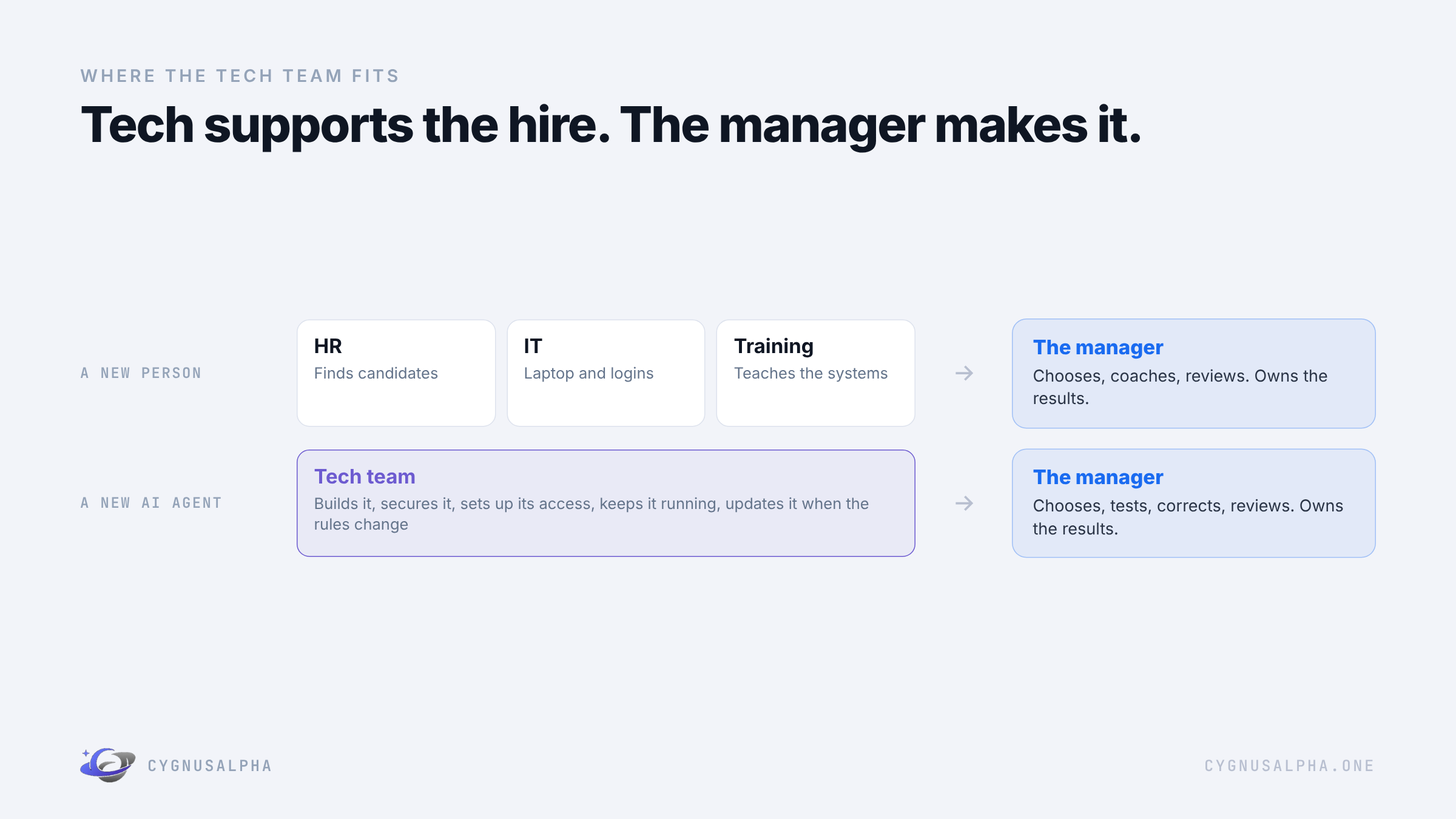
But HR doesn’t own how a new hire performs. The manager does. It should be the same for agents.
What we’ve seen
Our longest-running deployment is with a multi-brand consumer commerce and distribution business. Eighteen months ago, it started with one AI workflow, in customer service. Today it runs eleven, across purchase orders, merchandising and promotions, brand compliance, B2B sales and finance forecasting.
On the customer service queue, the team went from 11 people to 2.
Meera’s Monday, once this works
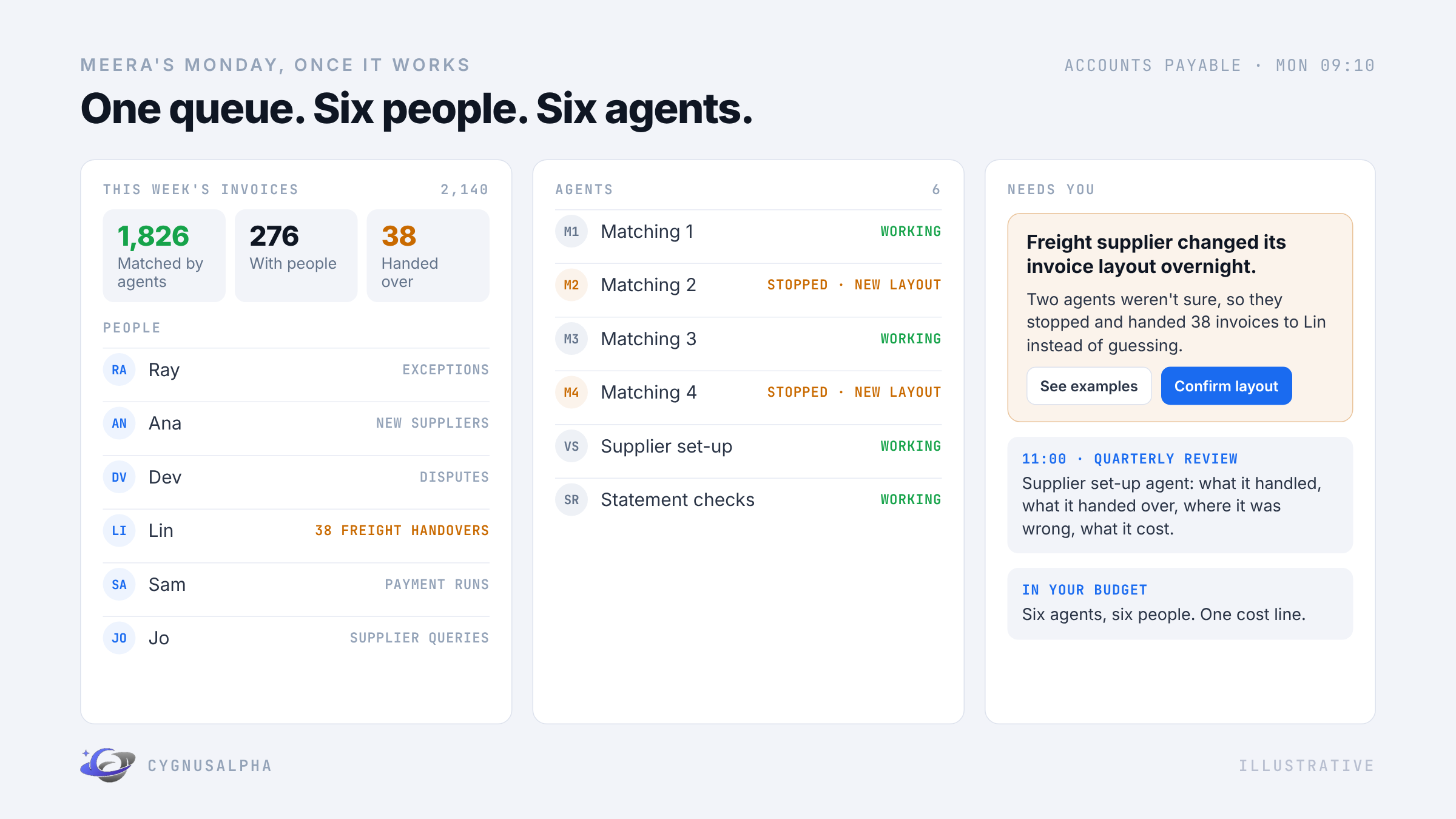
9:10 on a Monday. Meera looks at one screen: this week’s invoices, her six people and six agents, all on one queue.
Two agents are showing amber. The freight supplier changed its invoices again over the weekend. This time, both agents stopped and passed those invoices to a person instead of guessing. Meera looks at three of them, confirms the new layout, and saves the correction. By 9:40, both agents are matching freight invoices again.
At 11, she has a quarterly review with the agent that sets up new suppliers. It’s the same review she has with her people: what it handled, what it passed on, where it got things wrong, and what it cost. It’s in her budget, so the cost is her number too.
Her org chart looks the same as last year. Her team doesn’t.
HR took most of a century to learn how to hire, train and review people well. Operations teams won’t get a century to learn it for agents. The good news is that they already know most of it.
Meera, her team and her numbers are made up.
CygnusAlpha. We turn AI ambition into AI operations.
Sources: Philadelphia Inquirer on the Wharton study (13 Oct 2026) · Beri on ServiceNow’s Q3 call (29 Oct 2026) · ServiceNow Q3 2026 earnings call transcript