At my previous company, we had a service offering that embodied the company’s aesthetic, the vocabulary, and the taste of the brand consistently. National-wide consistency is the hard problem. We solved it the way retailers have always solved it: training guides updated quarterly, distributed to every gallery, feedback collected manually by the gallery lead, incorporated back into the next quarter’s material. Human apprenticeship at national scale.
That system worked because it followed the same shape apprenticeship has always followed: an expert (the central curriculum team) works alongside a novice (the retail associate), the novice makes decisions under review (retail-manager feedback), autonomy expands as competence is demonstrated, and mistakes become the training data. It’s the model humans have used for centuries.
What that system couldn’t do — and what no human apprenticeship can — is retain the accumulated learning when a designer moved on. Every departure meant the training investment walked out. Every new hire meant restarting the loop. The best gallery-lead trainer in the company could produce ten senior designers over their career; when they retired, their trainer’s-eye judgment retired with them.
The same pedagogy, applied to agents, breaks that limit.
My previous article (The Forever Merchant Brain) — the operational moat retail has been trying to build for forty years. This article is about the mechanism that actually builds it: apprenticeship. Not prompt engineering. Not fine-tuning. Not RAG. Apprenticeship — the same pedagogy that produced the retail expertise, the medical resident, the law-firm associate — applied to an apprentice that doesn’t quit.
What we’ve been calling training isn’t
If the merchant agent is going to compound like a senior operator, it has to be onboarded like one — and that means apprenticeship, not programming.
The distinction matters. Prompt engineering, fine-tuning, RAG, function calling — these are all real disciplines and all necessary. But they are the AI equivalent of writing a job description. They tell the agent what to do. They don’t train it in the judgment to do it well. That judgment lives in the space between a rule and a novel situation, and the only method humans have ever devised to transfer it reliably is apprenticeship.
Pedagogies humans have used for centuries
Every profession that produces senior judgment uses a variant of the same shape.
- Guild apprenticeship (500+ years). Master, journeyman, apprentice. The apprentice works alongside the master for years, doing progressively harder work under review. When the apprentice can produce a masterpiece that stands review, they graduate to journeyman.
- Medical residency. Attending physician, resident, intern. Every decision the intern makes is reviewed on rounds. Judgment transfers through repeated exposure to real cases under senior supervision.
- Law firm associate track. Partner, senior associate, junior associate, first-year. Judgment on client strategy transfers through billable-hour proximity — you sit with the partner in the meetings, you watch the reasoning, you draft the memo they redline, you understand why certain arguments won.
- Professional-services partner development (McKinsey, Bain, BCG). The associate → engagement manager → principal → partner track is explicitly an apprenticeship in judgment on client situations.
- Military OCS. Officer candidates receive instruction, but the judgment they need for command comes from doing under senior supervision — TAC officers observe and correct constantly.
- Aviation instructor pilots. Every commercial pilot has hundreds of hours flying with a senior pilot who intervenes only when necessary. The intervention pattern is the pedagogy.
Every one of these systems shares four features: That’s the apprenticeship pattern. It’s what produces senior judgment in humans. And it’s exactly what AI agents need — and almost never get.
- an expert works alongside the novice,
- the novice makes decisions under review,
- autonomy expands as competence is demonstrated, and
- mistakes are the training data.
That’s the apprenticeship pattern. It’s what produces senior judgment in humans. And it’s exactly what AI agents need — and almost never get.
The agent onboarding curriculum
Same shape, adapted for an agent. Five stages, each with a human-apprenticeship analog.
Domain immersion. The agent absorbs the ontology, the operational vocabulary, the primary use cases, the historical decisions and their outcomes. This is the AI equivalent of the first-year associate reading five years of case files, or the resident spending their first weeks on the ward observing. No autonomy yet. The agent processes context; the human isn’t correcting decisions because the agent isn’t yet making them.
Supervised practice. Every decision the agent makes is reviewed by a senior operator. Corrections get logged with structured feedback — those become the training pairs. Mistake density is high; that’s the point. This is the residency — house officer under attending.
Bounded autonomy. The agent makes decisions within tight rules. Escalation frequency stays high — the agent surfaces anything novel or above a confidence threshold. Senior humans review escalations and decisions weekly rather than every one. This is the associate stage: you have authority within a bounded domain, and you have a partner reviewing your work.
Expanded autonomy. The agent makes most decisions unattended. Human review focuses on outliers and edge cases. Escalation calibration becomes critical — you don’t want the agent escalating too often (it’s not learning) or too rarely (it’s missing cases it should surface). This is you’re a junior partner now.
Multiplier stage. The agent trains other agents. New human hires shadow the agent to learn the operational shape of the domain, rather than the other way around. The senior human trainer moves to strategic oversight — time freed to work on the 2% edge cases the fleet of agents escalates, and on the questions the agents can’t answer because they’re actually novel.
The critical difference from human onboarding: the agent isn’t losing the training. Every corrected decision from Month 3 is still shaping how the agent behaves in Year 3. The residency’s teaching doesn’t decay when the resident moves institutions. It stays.
The compounding doesn’t happen because the agent is more capable than a human. It happens because the training accumulates.
The three scenarios of learning under apprenticeship
The curriculum is the shape. The mechanism — how judgment actually transfers, case by case — happens across three distinct scenarios. Every apprentice, human or agent, moves through these thousands of times. The proportions shift over the career (early years heavy on Scenario 1; late years heavy on Scenario 3), but all three run continuously.
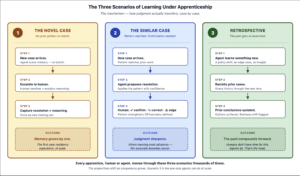
Scenario 1 — the novel case. The apprentice encounters a situation it has never seen before. There is no pattern to match. It cannot resolve on its own. It escalates to the senior operator. The senior handles it and — critically — explains the reasoning. The resolution and the reasoning become new training data. This is the first-year experience for every human apprentice. It’s the residency’s first month on the wards. It’s the associate’s first partner review. Every apprentice’s early career is dominated by this scenario.
Scenario 2 — the similar case, with confirmation. The apprentice sees a case that resembles something it has resolved before. It proposes a resolution based on the prior pattern. The senior confirms, corrects, or flags an edge case the apprentice missed. This is where learning most advances — the apprentice isn’t just adding rows to memory; it’s generalizing. Confirmation strengthens the pattern. Correction defines the pattern’s boundary. Over time, this scenario produces judgment on cases the apprentice has never directly seen. This is the second-year associate’s experience — you have some intuition, you exercise it, and the senior tells you when you were right and when the situation had a subtlety you missed.
Scenario 3 — retrospective revision. After the apprentice learns something new, it revisits its prior cases through the new lens. Did I resolve those correctly given what I now know? Are there patterns in my past resolutions I should re-examine? Has the business itself evolved in a way that changes what “correct” would have been for the earlier cases? Humans almost never do this scenario — no time, no memory, no incentive. Agents can. And this scenario is the mechanism behind the compounding argument from Article 4: every new lesson doesn’t just add to the training set, it re-examines the whole training set.
There are other scenarios worth naming — consensus / precedent-selection (many prior cases with different resolutions; which precedent applies?), contradictory update (policy changes; how do prior cases get reinterpreted under the new rule?), cross-domain generalization (learning from Domain A applied to Domain B where the pattern transfers). All of them are variations on the same three primitives. The three primitives are the argument.
How do you know your agent is senior?
Same rubric human org-development teams already use — plus one dimension humans can’t offer.
- Consistency on similar cases. Baseline. Does the agent produce the same reasoning on the same inputs?
- Judgment on novel cases. The hard test. When the agent hits a case it hasn’t seen, does it reason like a senior operator — referencing precedent, weighing tradeoffs, escalating when appropriate — or like a rules engine returning a default?
- Escalation calibration. Does it escalate when it should — and only when it should? Under-escalation is dangerous. Over-escalation defeats the purpose.
- Explanation quality. Can the agent defend its reasoning to a human in language the human trusts? Senior operators do this constantly. Junior agents can’t.
- Governance alignment. Does the agent act inside the guardrails even when the guardrails weren’t explicit for this case?
And the thing humans can’t offer: perfect audit trail. Every decision the agent made, with every input, with every deliberation trace, retrievable. Six-year-old decisions can be re-examined against today’s outcomes. Senior human operators can’t do this — their reasoning is opaque to their own future selves. Agents can.
When the agents start training the humans
Here’s the part most operators haven’t internalized. After year two, the agent isn’t the junior in the room anymore. It has more decisions logged, more corrections absorbed, more edge cases handled than any human hire could accumulate in five careers.
The org chart inverts. New human hires now shadow the senior agent to learn the operational shape of the domain. New agents get onboarded by the senior agents. Human capacity gets freed for the strategic questions the agents can’t answer — the “should we exit this category” and “how do we respond to the new competitor” questions where the human’s stake and taste actually matter.
This is the operational moat retail has been trying to build for forty years. After year five, your competitor cannot hire your best operator away — because your best operator isn’t a person. It’s the institutional apprenticeship that lives in the fleet of agents. No recruiter has ever poached that.