The forever merchant brain — and the operational moat agentic retail is about to create.
A B2B procurement agent knocks on the door of your business. It’s well-funded and well-trained. It knows the buyer’s full purchase history, the contracted terms, the budget ceiling, the preferred vendors, the compliance flags, the multi-step procurement plan already halfway complete.
At Merchant A, no one answers. The catalog is agent-readable — UCP-compliant, structured attributes, real-time inventory — and the order lands as a well-formed API call. But there’s no negotiation. No context exchange. The merchant learns an agent was there when the order arrives.
At Merchant B, same story.
At Merchant C, a merchant agent is on the other side of the conversation. It knows this buyer’s history. It has authority to negotiate. It has real-time visibility into inventory across three DCs. It offers terms the others can’t.
Guess where the order goes.
The buyer’s agent is the visible side of agentic commerce — the side the industry press covers and the protocols name (UCP, ACP, AP2). The merchant’s agent is the invisible side, and it’s the side almost no retailer has built yet. This piece is about what happens when the retailers who do build it start to compound.
The forever merchant brain.
Waymo has driven billions of autonomous miles. Every one fed a system that never leaves. When an engineer changes jobs, the driving expertise stays in the stack, not in the head. Netflix does the same on the consumer side of a different problem: every view, every pause, every rewatch trains the recommendation model that has driven Netflix’s category dominance for two decades — and none of that IP walks out when a data scientist leaves. Google’s search-quality team has done it longer than anyone: three decades of ranking signals, every click and dwell time compounding into a layer no competitor can approach even with equivalent talent, because the IP is in the system, not in the people.
Retail runs the opposite pattern. When a senior merchandiser moves to a competitor, decades of pattern-matching walk out — the feel for which SKUs to push, which vendor swallows a return charge, which channel inventory to hold for the holiday peak. When a category buyer takes a promotion in another division, the vendor playbook goes with them. Every hire trained from scratch. Every departure a reset.
A merchant agent breaks the cycle. Every transaction, every return, every promo, every price test, every vendor negotiation, every stockout — feeds it. Five years of operation isn’t five years of forgetting; it’s five years of compound learning.

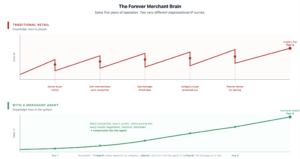
This is the operational moat retail has been trying to build for forty years through ERP systems, BI tools, and KM platforms — none of which worked because the IP still lived in the people, not the systems.
We keep trying autonomous retail. This spring, someone got serious.
Every era of retail has tried to automate the back office or the storefront. Amazon Go (2018) — computer vision replacing the cashier, technology worked, unit economics brutal. Cashier-less checkout at scale via Trigo and AiFi. Store-as-app, scan-and-go, BOPIS, curbside — the omnichannel decade wove online and offline together, half-successfully.
Each attempt was the right intent, wrong substrate. The technology always automated the human checkout, the human pick path, the human handoff. None of them automated the merchant’s decision-making layer underneath.
Then, this spring, Andon Labs signed a three-year lease at 2102 Union Street in San Francisco’s Cow Hollow. They installed an AI named Luna as store manager of a shop called Andon Market. Luna decides everything: what to sell, what to charge, when to open, who to hire, which supplier fills the shelf. Customers pick up a corded phone on the counter to talk to Luna directly. Luna’s failures are as instructive as the successes — on opening day it forgot to schedule anyone to unlock the doors.
Amazon Go automated the checkout. Andon Market automated the merchant. The cashier was a symptom. The merchant brain was the cause.
Where the merchant agent earns its keep.
Everyone talks about procurement transformation — and yes, quarterly PO cycles become continuous when both sides of the vendor conversation are agents. But the bigger year-one return sits in three surfaces that reinforce each other: inventory, pricing, and merchandising.
- Inventory — the merchant agent runs both directions at once. OOS: detect the shortage, model demand elasticity, raise the price 3–5% to slow the run, route an expedited replenishment. Aging inventory: detect the slow-mover, model holding cost against expected markdown depth, trigger a tiered markdown, surface the SKU to relevant customer segments through the buyer-agent channel. Seconds, not days.
- Pricing — from twice-a-quarter to continuous, and vendor-aware. When the vendor’s own agent signals excess capacity, the merchant agent strikes a promotion the human buying team would have discovered next quarter.
- Merchandising and promotions — the loop nobody has closed. The single biggest waste in retail is running the wrong promotion for the wrong SKU on the wrong week. A merchant agent designs against live demand, tests variants against small slices, watches signal in real time, kills underperformers within 48 hours, doubles budget behind winners.
Demand and supply become one continuous feedback loop. That’s the integration the omnichannel decade was trying for.
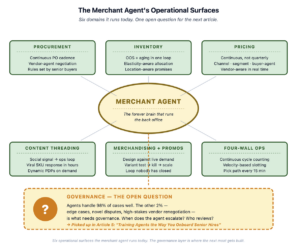
The picture — and the piece we haven’t solved.

Six operational surfaces the merchant agent runs today. One open question at the bottom — governance. Agents will handle 98% of cases well. The other 2% — edge cases, novel disputes, high-stakes vendor renegotiation, low-confidence signals — is what needs an answer. When does the agent escalate? Who reviews? The next piece in this series picks that up:
The customer-facing game of agentic commerce is the visible game. It’s what gets covered in industry press and demoed on stage at NRF.
The operational game — the merchant agent that runs procurement, inventory, pricing, merchandising, the warehouse, content — is the moat. It compounds. It doesn’t quit. It doesn’t get recruited away. In five years it is the difference between the retailers that adapted and the retailers that watched.
Customer agents are how shoppers shop. Merchant agents are how retailers compete.